CamSoda’s on-off relationship with live VR camming is back on – thanks to a new partnership with Dreamcam.
If that sentence gave you déjà vu, you’ve been around long enough to remember the last two attempts!
The CamSoda platform, created by Daron Lundeen in 2014, has been chasing the VR dream for the better part of a decade.
It was one of the first major sites to go all-in on VR. Way back in 2015, when most of us were still strapping phones into Google Cardboard headsets, CamSoda launched live 360-degree VR streams using a Frankenstein setup made from six GoPros stitched together in real time.
Lundeen said back then: “Virtual reality is quickly becoming one of the most talked about subjects within the industry for its potential to provide users with a truly immersive and transformational experience.”
So… many years have passed since then.
What the hell happened?
CamSoda’s Previous Dabbles with Virtual Reality
While the initial launch made headlines, VR cams in 2015 were a notoriously hard sell.
This was a time when the total Oculus install base was somewhere around 300,000 units worldwide – DK1 and DK2 combined – and the consumer Rift hadn’t even shipped yet. CamSoda was, in effect, broadcasting to a developer conference.
The initial wave of interest passed with minimal commercial uplift.
Undeterred, however, Soda came back swinging in 2018 with something called VIRP – “Virtual Intercourse With Real People.“
This lavish contraption paired live VR shows with a $1,500-to-$10,000 RealDoll fitted with a Lovense Max sex toy on the model’s end, all synced to a Kiiroo Onyx on the user’s end.
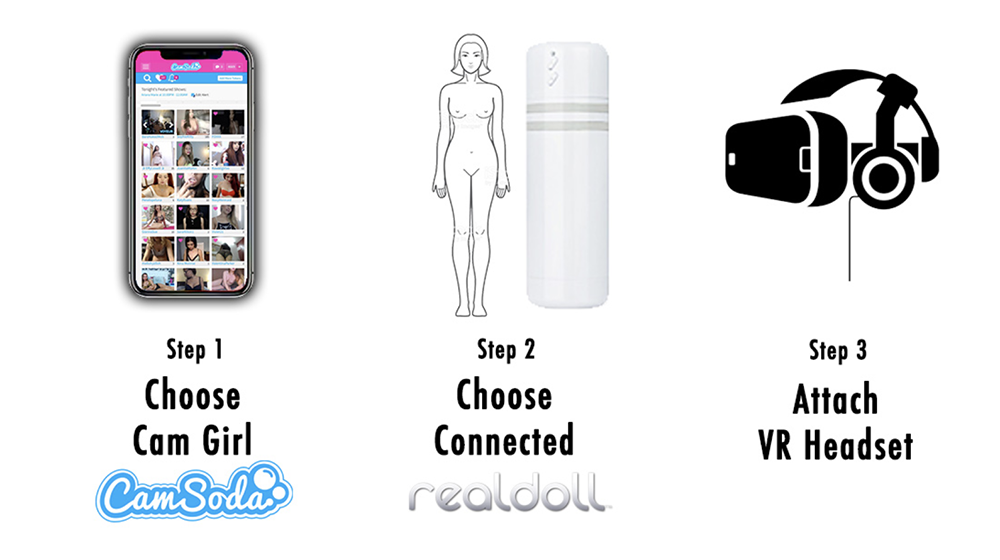
The PR dubbed it a “game changer” for the industry, but here we are, eight years later… safe in the knowledge that not much has actually changed.
By 2019, the VR section on CamSoda had basically fallen off the radar.
While you can comb through their support docs and find references to “Thursday-night live VR shows“… these are from years ago. And until just recently, the VR tag on the CamSoda site was producing exactly nil streams.
(Enough for us to pronounce it pretty much dead on the (very short) shortlist of VR cam competitors.)
Which brings us to February 2026… and CamSoda’s third swing at the VR piñata.
The eight-year intermission was filled with the kind of stunt PR CamSoda has built its name on – the $69,000 offer to Queen for the rights to “Fat Bottomed Girls,” the $250,000 letter to Olympic pole vaulter Anthony Ammirati, a trendy AI Girlfriend Builder rolled out in 2024.
Virtual reality, conspicuously, has stayed out of the conversation.
Until now…
This time around, the strategy looks rather different… because CamSoda isn’t building anything themselves.
By tapping into DreamCam, they are partnering with a company that has the exact infrastructure to gain traction in a notoriously difficult market.
The New Partnership with DreamCam
DreamCam is the only off-the-shelf adult live-VR streaming vendor in the market with a proven track record.
It started in 2015 as a mainstream live-VR sports and entertainment broadcaster, then pivoted hard and fast – having raised $5 million in venture capital – into the much more lucrative business of streaming naked people in stereoscopic 180°.
The original product specs were solid if unspectacular: 4K at 50fps, 10 Mbps, an 78ms latency claim, with compatibility across Oculus Quest, Rift, Vive, Gear VR and the rest of the 2022 headset zoo.
Stripchat, xHamsterLive and SexLikeReal were the three flagship launch partners. And if you’ve been following the VR camming space, you’ll know that today, these are basically THE names in the space.
CamSoda is, then, the fourth major adult cam ecosystem to be running on DreamCam’s stack.
Coming last to the only available vendor is not exactly the swashbuckling early-adopter positioning that Lundeen liked to spin in 2015, but it has a much better chance of succeeding in the long-term.
The reason for that is because, as we’ve seen, building VR cam infrastructure from scratch is a fool’s errand for a platform of CamSoda’s size.
The technical problems that sank CamSoda’s first two attempts have, by now, been solved elsewhere. DreamCam already runs at scale on Stripchat – by some distance the largest VR cam audience in the world. The stack has been battle-tested and if we’re being honest, the sector hasn’t seen enough growth to justify anything more than a convenient licensing agreement – at this point.
The Twin Challenges To Growth
Even with DreamCam’s plug-and-play infrastructure, CamSoda is walking into a category with two structural problems that no amount of slick streaming tech can solve.
There’s a reason why other cam giants like Chaturbate and MFC have been keeping schtum, reluctant to jump on the virtual reality train.
1. Getting models on board
Easier said than done!
To broadcast in VR, a model can’t just point their MacBook camera at a bed and start chatting. They need a stereoscopic 180° rig, broader and softer lighting to fill the wider field of view, a bigger room than the standard cam corner, decent upstream bandwidth, and the patience to learn an entirely new performance style.
Things like camera distance matters more. Movement certainly plays a part. The whole “lean into the webcam and read the chat” formula is more likely to induce missing limbs in a VR environment.
It’s a completely different sell to a model who just wants to make bank with minimal fuss.
Stripchat has tried to brute-force this problem by offering models a 40-60% private-show premium on VR rooms – yes, basically bribing them into the kit. Even with that incentive in place since 2019, VR-capable models remain a tiny minority of the platform’s total broadcaster base.
At the time of writing, StripChat’s online VR performers total 126 from 6870 live. CamSoda has a lot of ground to make up – currently just 12 streams live, less than 10% of the total audience.
If Stripchat – the largest cam site in the world by traffic – can’t get more than a sliver of its models to invest in stereoscopic gear, CamSoda re-enters the market a long way back.
And it’s mostly because the chicken-and-egg loop is brutal.
Models won’t invest in VR rigs until there’s reliable VR demand. Viewers won’t invest in headsets just to watch live VR cams. In a cruel twist, many of the most likely consumers need a ‘white-hat’ decoy that justifies the purchase. Walkabout Golf, boys?!
2. Is the VR market actually growing?
The second problem is the more uncomfortable one.
The VR space itself isn’t really expanding right now.
Certainly not in a meaningful way.
The overall figures are just not that encouraging. According to market research firm IDC, Meta’s Quest shipments declined 16% year-on-year in 2025.
The broader VR/MR category is forecast to contract by 42.8% overall. Meta has visibly pivoted its attention – and its R&D dollars – towards Ray-Ban smart glasses, which Zuckerberg told investors had “tripled in sales in the last year“.
In other words… it’s out with VR, and in with XR.
(Maybe “Ray-Ban Porn” will be the next big thing?!)
While it remains true that there are 25-30 million Quest headsets in the wild – vastly more than in 2015 – total VR users and active VR users are very different things. Many of those Quest headsets bought as Christmas gifts are now gathering dust in a drawer next to other casualties of passing fads.
Even for those who enjoy consuming NSFW content in VR, the market for cam content is something of a niche within a niche.
Live VR cams are squeezed between traditional flat-screen cams (easier, better-populated, no headset required) and pre-recorded VR porn (prettier, higher-production, already there when you want it).
All this is to say that CamSoda is unlikely to reinvent the wheel with its latest foray into VR cams, but it might make up some lost ground to Stripchat.
Have you tried live cams in VR?
What did you make of the experience?