If you’ve spent any time browsing adult visual novels – on Itch.io, F95Zone, or Steam’s increasingly liberal back catalogue – you’ve probably noticed engine names thrown around like they’re supposed to mean something.
“Built in Ren’Py.” “Requires RPG Maker RTP.” “Made with Unity.“
As far as most players are concerned, these labels might as well have been written in Klingon. You just want to know if the game runs, if the art’s good, and whether the writing’s worth a damn, right? Fair enough.
In reality, though, the engine a developer chooses fundamentally shapes the kind of game you end up playing. It dictates everything from the interface you’re clicking through to the kinds of scenes that are technically possible, to whether the thing will actually run on your seven-year-old POS laptop.
So what do all these engine names actually mean – and why should you care?
In this guide, I’ll be breaking down the most popular engines used by adult visual novels and sex game devs. We’ll explain what each one does, the main reason why developers choose it, and what it means for you as a player.
(If you’re looking for our ranked lists of the best AVNs, we’ve got a separate guide for that. This one’s purely about the tech!)
Why Does The Engine Matter?
Obviously… the engine is not the whole game.
A brilliant writer can produce a masterpiece in basically any engine, and a lazy developer can produce absolute dog shite in the most powerful tool on Earth.
But with that said, certain engines lend themselves to certain types of gaming experiences.
A tool built specifically for branching dialogue and static images will produce a very different game than a full 3D engine with physics and real-time rendering. And in the adult space – where developers are often solo creators or tiny teams working on shoestring budgets – you’ll find that, ultimately, the engine choice is often less about ambition and more about practicality.
The adult game development scene is overwhelmingly indie.
We’re not talking about EA-sized studios here. There is no “Rockstar of adult gaming“, and not just because porn games are banned on consoles. More often, we’re talking about one person with a copy of Daz 3D, a writing habit, and a Patreon page. The tools they use need to be accessible, affordable, and permissive enough to actually allow explicit content.
That last point… matters more than you’d think…
So What Engines Are Popular With Adult Devs?
Here’s a rundown of the engines you’ll encounter most often in the NSFW gaming wild – what they do, why devs love them (or tolerate them), and ultimately what each one means for your experience as a player.
Ren’Py
Ren’Py is, by some distance, the most famous engine in the adult visual novel genre.
This engine (a portmanteau of “ren’ai,” the Japanese word for romantic love, and “Python,” the programming language it’s built on) is a free, open-source visual novel engine that has absolutely dominated the adult game development space for over a decade. It was created by Tom “PyTom” Rothamel, with its first stable release arriving over twenty years ago (in 2004).
The numbers speak for themselves. Head over to F95Zone – the largest English-language adult gaming community – and the vast majority of games listed there are built in Ren’Py.
Why is that?
A few reasons…
First, it’s really easy to learn.
Ren’Py uses a simple scripting language that reads almost like plain English. A basic scene – character appears, dialogue plays, player makes a choice – can be set up in minutes by someone with zero coding experience. The learning curve from “I’ve never made a game” to “Oh shit, I have a playable demo” is remarkably shallow.
Second, it’s free.
Completely, totally, no-strings-attached free.
For solo developers funding their work through Patreon (a critical market) or Subscribestar, that makes a massive difference. There are no licence fees, no royalty payments, no restrictions on commercial use.
Third – and this is the big one for adult content – Ren’Py has zero content restrictions. The makers of the engine do not care what you put in your game, so there are no terms of service prohibiting explicit material, no risk of having your project pulled from a storefront because the engine maker decided to crack down.
The result is that Ren’Py has become the lingua franca of adult visual novels. Games like Summertime Saga, Being a DIK, Milfy City, and hundreds of other well-known Patreon-funded titles are all built on it. If you’ve played an adult visual novel in the last five years, there’s a very solid chance it was a Ren’Py game – whether you knew it or otherwise.

The trade-off is that Ren’Py is purpose-built for visual novels – static images, dialogue, branching choices, and not much else out of the box.
So if an adventurous dev wants to add gameplay mechanics like minigames, combat, or sandbox exploration, they can do it (Ren’Py is extensible through Python), but it requires a lot more technical skill. Some developers have indeed pulled off impressive sandbox-style games in Ren’Py, but it’s only by hacking the engine to do things it wasn’t really designed for. And if you’ve ever tried this, you’ll know that it’s… not exactly fun.
In default form… for the player, a Ren’Py game typically means a clean, functional interface with left-click-to-advance storytelling, a save/load system, a choice menu, and a gallery. It’s not flashy, but it gets the job done.
RPG Maker
RPG Maker is a slightly more ambitious choice for a game engine. It’s what developers reach for when they want their work to feel more like a “traditional” RPG.
RPG Maker is actually a series of game creation tools – with versions like RPG Maker VX Ace, MV, and MZ being used often – and it was originally designed for creating 2D Japanese-style role-playing games. By that, I mean Final Fantasy-style top-down worlds with tile-based maps, character sprites, turn-based combat, inventory systems and so on.
Admittedly, that might not sound like an obvious fit for adult content.
But devs figured out something clever years ago: RPG Maker’s structure is perfect for the kind of gameplay loop where you explore a town, interact with characters and unlock scenes as rewards. And this, of course, is a hook we see in the genre time and time again.
The idea is to give the player something to do between the porno fan service – to offer a sense of progression, exploration… a little earned gratification that a pure visual novel can’t easily replicate.
Games like The Forgotten Island, School of Lust (see below), and a mountain of RPG Maker titles on F95Zone use this formula to great effect.
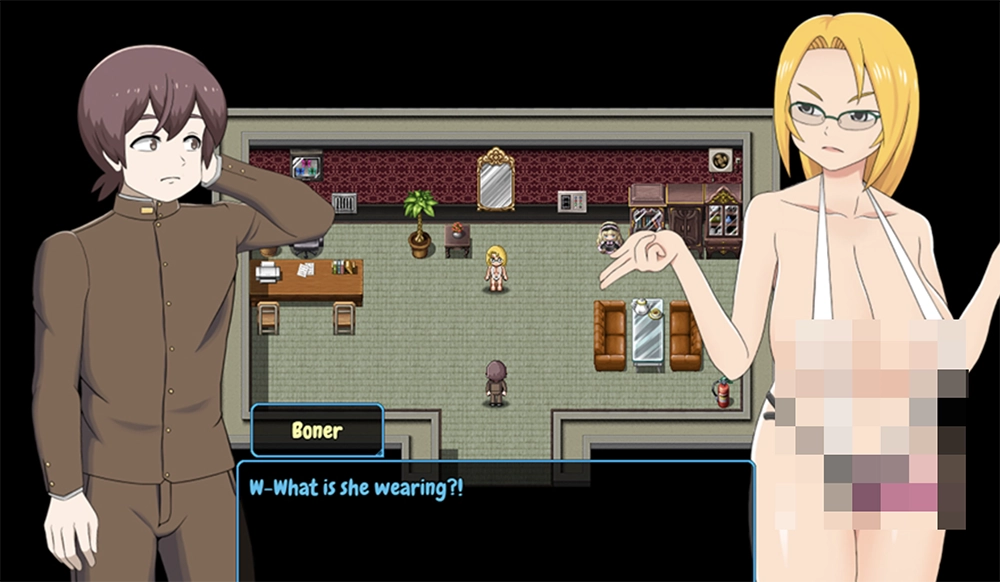
You wander around a 2D world, talk to characters, make decisions, fight some harems or solve some puzzles, and the X-rated content is woven into a dopamine-triggering progression system.
RPG Maker isn’t free – I believe licences are around $70–$80 at full price depending on the version (MZ, the latest is currently $79.99), but Steam sales regularly slash these to a fraction of that. It’s cheap enough to be accessible for indie developers, or at least those with some commercial intentions.
And while it comes with a tile-based art style out of the box, most adult game developers use custom assets, plugins, and image overlays to display their own artwork (often Daz 3D renders or hand-drawn CG sets) during dialogue and scene sequences.
My biggest complaint is that RPG Maker games can feel… clunky. I mean, it’s like playing the earliest console games.
The default movement system is grid-based and it’s kinda stiff. Performance can also be notably wobbly, especially with heavily modded projects spooging through dozens of plugins. And there’s a ceiling to what the engine can do visually… you’re never going to get cinematic 3D scenes or fluid animation out of it.
For the player, an RPG Maker adult game means something a little more sophisticated than the typical AVN. You can expect exploration to form a key mechanic. Expect to occasionally get lost in a dungeon or stuck on a quest with no clear direction. And expect to install the RTP (Runtime Package – a set of default assets the engine needs to run) at least once in your life.
Unity
I recently ran an analysis of the most popular engines in Steam’s NSFW section, and Unity was by far the top choice. It was the chosen engine for 16 of the top 20 most-played adult games.
That’s no surprise really given that Unity is the big dog of indie game development.
It’s a full-featured, professional-grade game engine used to make everything from Hollow Knight to Pokémon GO to Escape from Tarkov. It handles 2D, 3D, VR, mobile…
So naturally, some adult game developers have gravitated toward it.
And it’s usually the one with commercial aspirations and deeper pockets.
Unity-powered adult games tend to be the most technically ambitious projects in the space. Often kitted out with full 3D environments, real-time character rendering, deliciously animated sex scenes, sandbox gameplay, and sometimes even VR support. Games like Honey Select and Koikatsu by Illusion (now sadly shuttered), Wild Life by Candy Valley, and numerous character creator-style adult games are all built on Unity.
The appeal for developers is power and flexibility.
Unity can do things that Ren’Py and RPG Maker simply can’t.
- Want a fully explorable 3D apartment with physics-based interactions?
- Want real-time lighting and dynamic camera angles during a sex scene?
- Want your game to export to Windows, Mac, Linux, Android, and VR headsets from a single project?
Unity answers the call.
This power under the hood comes with complexity that deters many smaller-time devs.
Unity has a steep learning curve compared to Ren’Py or RPG Maker. It’s a professional tool designed for professional developers. A solo creator going from zero to a finished Unity game is a dramatically bigger undertaking than doing the same in Ren’Py, which is one reason why Unity-based adult games tend to have longer development cycles, more ambitious scope, and a laughably absurd rate of abandoned projects.
Then there’s the licensing question.
Unity’s pricing model has been… let’s diplomatically say controversial over the years.
The engine is free for developers earning under $200,000 in annual revenue, which covers most adult game creators, but the uncertainty around future pricing changes has made some developers nervous.
Unity’s 2023 runtime fee debacle – where they briefly tried to charge developers per-install before a massive industry backlash forced a reversal – didn’t exactly inspire confidence within the community. Many have since taken a pretty dim view of using the engine.
While Unity itself doesn’t explicitly ban adult content, it also doesn’t go out of its way to support it. The engine’s asset store doesn’t allow sexually explicit content, and games published through certain Unity-connected platforms can (and do) face content restrictions.
With all that said, when it works well… it’s still the gold standard.
A Unity game usually means: bigger downloads, more system requirements, but with impressive visuals – and also a greater chance of bugs & performance issues. And a very high chance it gets abandoned.
Unreal Engine
Epic Games’ Unreal Engine – currently in its fifth major version – is the engine behind blockbuster titles like Fortnite, Final Fantasy VII Remake, and a raft of AAA games with infinitely more commercial potential than our typical smut game.
The engine is most renowned for its rendering capabilities, with photorealistic visuals that can make your jaw hit the desk. This is the ultimate hot sauce for any aspiring/ambitious sex simulator.
In the adult game space, Unreal is relatively rare – but when it shows up, you notice. Projects like Subverse (by Studio FOW) and a handful of other ambitious titles have used Unreal to deliver visual quality that’s leagues beyond what you’ll see in a typical Ren’Py or RPG Maker game.
But if it’s so powerful, why don’t more adult developers use it?
Because most devs just don’t have the budget… or the time… to make it work.
Unreal is a beast of an engine. The learning curve is a vertical cliff face. Take a deeper look and you’ll find the development pipeline requires serious technical skill across 3D modelling, animation, materials, lighting, and either Blueprints (Unreal’s visual scripting system) or C++.
For a solo developer or small team, that’s an enormous ask for a genre of games that still has limited appeal in the mainstream.
Hardware requirements are also brutal – both for development and for playing the finished game. Compiling an Unreal project without a beefy machine is an exercise in patience. And the resulting game files tend to be massive.
Unreal’s licensing is actually quite generous for indie developers. It’s free to use until your game earns over $1 million in lifetime gross revenue, at which point a 5% royalty kicks in. For the vast majority of adult game developers, that threshold is comfortably hypothetical.
Godot
Godot (pronunciation hotly debated – the creators prefer “GOD-oh,” others say “guh-DOH” like the Beckett play, and some just say “go-DOT” – pick your poison!) is an engine that developers have been increasingly excited about in recent years… especially since Unity’s 2023 pricing clusterfuck sent shockwaves through the indie community.
Godot is completely free, fully open-source (MIT licence), and has zero royalty fees or revenue caps.
It’s community-developed, which means no single corporation can suddenly change the terms on you. That means Godot represents a philosophical alternative as much as a technical one.
In terms of capability, I would say that Godot sits somewhere between Ren’Py and Unity…
Yes, it handles 2D games beautifully and has solid (if not Unity-tier) 3D capabilities. Its scripting language, GDScript, is Python-like and relatively easy to learn. It’s certainly versatile enough to build visual novels, RPGs, sandbox games, and point-and-click adventures.
In Steam’s Top 20, it currently has just the one game using its engine – LoveCraft – with the reviews “mostly positive“.
I’d expect that number to grow, but for now, Godot is still the new kid on the block. Its market share is considerably smaller than Ren’Py’s, but it is growing.
Developers who want more flexibility than Ren’Py offers but don’t want the complexity (or corporate baggage) of Unity are increasingly giving Godot a serious look.
The drawbacks are largely about the maturity of the ecosystem. Godot’s plugins, documentation, tutorials, community asset… is smaller than Unity’s or Ren’Py’s. If you hit a specific technical problem, there are fewer Stack Overflow threads and YouTube tutorials to bail you out. The 3D pipeline still isn’t on par with Unity or Unreal for visual quality.
Watch this space?!
Twine
Not every adult game needs graphics, and although you would certainly expect them with an “adult visual novel“, Twine deserves a mention.
This is a free, open-source tool for creating interactive fiction – link-driven “choose your own adventure” stories brought to you in a naked web browser. That means it has no images required. No engine to install. Just words, choices, and consequences.
If that sounds simplistic… well, it is.
And that’s the point.
Twine’s appeal is its absolute accessibility. We’re stripping everything back here. If you can write, you can make a Twine game. The tool uses a visual node-based editor where you create passages of text and link them together with choices. The output is a single HTML file that runs in any web browser on any device.
For adult content creators who are writers first – whose strength is narrative, characterisation, and branching story design rather than visual art or programming – Twine is a revelation. And the adult interactive fiction community, particularly on sites like TFGS (The Friendly Game Site) and certain corners of Itch.io, is surprisingly busy.
Degrees of Lewdity, one of the most popular text-based adult games, is a Twine project that has been in active development for years and rocks a staggering amount of content.
I would start there if you want to see this engine in its pomp.
Just keep in mind, there are very few visuals (unless you get creative), but it’s ripe for the niche audience that specifically enjoys reading-heavy experiences.
TyranoBuilder / TyranoScript
While Ren’Py dominates the English-language adult VN scene, the Japanese doujin community has its own ecosystem… and TyranoBuilder plays a key role.
This is a visual novel creation tool available on Steam for around $15, with a drag-and-drop interface that makes it accessible to non-programmers. Under the hood, it runs on TyranoScript, a scripting language that offers more flexibility for developers (or anybody willing to get their hands dirty).
The engine handles the standard visual novel toolkit competently: character sprites, backgrounds, dialogue, branching choices, text effects, and basic animation.
t also supports live2D integration, which allows for that distinctive animated character style you see in a lot of Japanese VNs… characters that breathe, blink, and react with subtle little motions that bring the scene to life.
TyranoBuilder’s market share in the English-language adult game space is relatively small.
Most Western adult VN developers default to Ren’Py, which has a much larger English-speaking community, more tutorials, and better documentation.
Wolf RPG Editor
Wolf RPG Editor is a free, Japanese-developed RPG creation tool, and another that has been quietly popular in the Japanese indie and doujin game scene for several years.
Functionally, it’s very similar to RPG Maker – tile-based maps, event systems, character sprites – but it has the advantage of being completely free with no licence restrictions.
In the English-speaking adult game community, Wolf RPG Editor games are really uncommon – I can’t think of any major hits – and you’ll mostly encounter them as fan translations of Japanese originals.
But in the Japanese adult doujin space, it has a dedicated following among creators who want RPG-style gameplay (without shelling out for an RPG Maker licence).
The Engine Doesn’t Make the Game
As you can see, a modern adult game dev has plenty of engines – and tools – at his/her disposal.
But as a gamer, should you ever choose a game based on the engine alone?
Fuck no.
The engine is just a means to an end, and while it can be indicative of the type of game, it gives no indication of the underlying quality.
I’ve played absolutely brilliant adult visual novels in Ren’Py – games with writing, characterisation, and emotional depth that would rival the heaviest-hitting commercial fiction.
I’ve also played Unreal Engine adult games with the appeal of a dead fish. More power does not mean a better experience, especially in a genre where fan service so often wins the day.
A Unity game isn’t automatically better than a Ren’Py game because it has 3D graphics. A Twine game isn’t automatically worse because it’s “just text.”
What matters, as always, is the craft – the writing, the art, the design, the TLC a developer puts into the experience.
That said, knowing what engine a game uses does give you useful information. It tells you roughly what kind of experience to expect, what system requirements you’ll need, and – in some cases – how likely the project is to ever be completed.
A solo developer promising a AAA-quality Unreal Engine game funded by $500/month in Patreon income? Yeah, I’m gonna wait to see the evidence of that one, bud!
The adult game development scene is one of the most creatively diverse corners of indie gaming, and the engines these developers use are a big part of why.
The next time you download an adult visual novel and see that engine label, I hope you’ll know exactly what you’re getting into.
Or at least… you’ll have a much better idea. 😉
What’s your engine of choice as a player – or as a developer? Have we missed any engines that deserve a mention? Let us know!