OnlyFans is back in the headlines with the shocking news that founder Leonid Radvinsky is dead.
The reclusive Ukrainian-American billionaire who owned OnlyFans – the man who turned a modest British subscription platform into a $7.2 billion juggernaut – died of cancer on March 20th, 2026.
He was just 43 years old.
Radvinsky was the invisible hand behind the most culturally significant adult platform of the 2020s, a man who bought 75% of Fenix International in 2018 for a reported $30 million and watched it balloon into one of the biggest adult entertainment companies on the planet.
He made roughly $2 million per day from a platform most people associate with bedroom selfies and amateur adult DMs. And yet most of the creators on his platform… the ones actually producing the content that generated those billions… earn less per month than a decent dinner for two in London.
OnlyFans paid out $5.8 billion last year, but this is the reality for most models on the platform.
What Do OnlyFans Models Really Earn?
Most of us have the false expectation that OnlyFans models are somehow minted – laughing their way to the bank on a sea of selfies and bathroom mirror shots.
Some are.
Most are not.
The average OnlyFans creator earns $131 per month after the platform takes its 20% cut.
The median sits around $180/month. That’s roughly $2,000 a year.
Not exactly inspiring stuff, or enough to sack off the day job.
Now, before you dismiss those numbers as skewed by millions of dormant accounts (a fair objection, and one we’ll get to), consider the distribution. Because OnlyFans’ income inequality is enough to make a Victorian factory owner blush…
OnlyFans Earning Tiers
- The top 0.1% of creators earn approximately $146,881 per month and capture around 76% of all platform revenue
- The top 1% earn over $6,000/month and take home 33% of total earnings
- The top 10% earn over $1,000/month and account for 73% of all revenue
- 40% of creators earn under $10 per month
Not to get too technical here but the Gini coefficient – the standard measure economists use for income inequality – sits at 0.83 for OnlyFans. For context, South Africa, one of the most unequal societies on Earth, has a Gini of 0.68.
Matthew Ball’s deep-dive into OnlyFans’ economics lays this out in forensic detail.
But it boils down to…
OnlyFans is less equal than an ex-apartheid state.
We’re not saying this is a good thing, or a bad thing. But if you are a model, or somebody aspiring to make money on OnlyFans, you really do need to consider the slim chances of actually succeeding.
The Billion-Dollar Illusion
OnlyFans loves to trumpet its big numbers, and it’s easy to see why – they are biiiiiiiig, with a capital B-I-G.
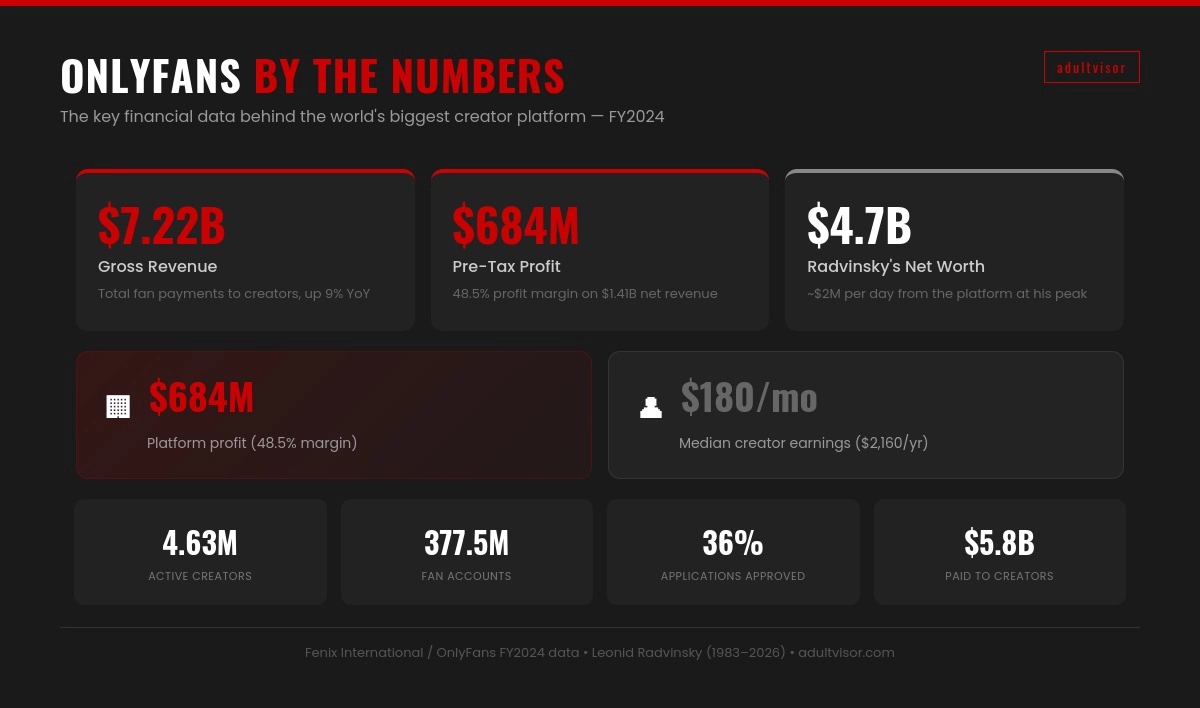
In fiscal year 2024, the platform reported $7.22 billion in gross revenue (total fan payments to creators), which was up 9% year-on-year. Net revenue hit $1.41 billion. Pre-tax profit was $684 million. The platform paid out $5.8 billion to its 4.63 million creators, servicing 377.5 million fan accounts.
If we divide that $5.8 billion payout by those 4.63 million creators and you get an average of $1,253 per creator for the entire year.
That’s the average.
The median is far worse.
And this is what any aspiring model needs to understand, because it’s a key point that the “become your own boss on OnlyFans!” crowd rarely mentions: those aggregate numbers are almost entirely driven by a tiny elite.
Those big earners are the equivalent of ‘whales’ on a cam site.
One of the most famous whales of all, Sophie Rain, reportedly earned $43.5 million in her first year on OF.
Bella Thorne pulls in $37.3 million annually (she was the the first person to earn $1 million in the first 24 hours of joining the platform!). The former Aussie rapper, Iggy Azalea, claims $36 million.
These are extreme numbers, and nobody would be surprised that they are NOT representative examples of the OnlyFans creator experience – they’re statistical outliers so extreme they’d be thrown out of any serious data set.
For comparison, even traditional porn star salaries – hardly a get-rich-quick scheme themselves – look modest next to the money these girls are printing.
The typical OnlyFans creator experience looks more like this: you spend weeks building a profile, shooting content, learning the platform’s quirks, marketing yourself on Twitter and the right NSFW subreddits and TikTok (whilst carefully not violating their content policies).
If you’re lucky… you get a handful of subscribers. You send mass messages with PPV content. A few people buy. Most don’t.
After the platform’s 20% cut, you’ve made enough to grab yourself a Deliveroo and a bottle of wine.
And that’s if you’re actually approved.
Only 36% of creator applications get the green light to produce content.
Where The Money Actually Comes From
One of the most misunderstood things about OnlyFans is what actually generates the revenue.
How do the stars make their money?
Like most people, we always assumed it was the subscriptions – the monthly fee fans pay to access a creator’s feed.
In reality, 60% of OnlyFans revenue comes from single purchases, not subscriptions.
Yes, the real money is in DMs.
Top-earning creators consistently report that private messaging generates 40-60% of their total income.
This includes everything from custom content requests, to tip-driven conversations (sexting), and exclusive pay-per-view drops sent directly to fans’ inboxes. The subscription fee is really just the cover charge to get through the door; a supplementary income.
The actual revenue comes from the personal interaction (or the illusion of it, but more on that shortly). If you’re interested in the broader world of getting paid to sext, OnlyFans isn’t even the only option – though the dedicated sexting apps have their own economics to contend with.
This is why OnlyFans’ official line about being a “creator subscription platform” has always been slightly misleading.
It’s actually a relationship monetisation engine that happens to use subscriptions as the entry point. The creators who understand this – the ones who treat DMs as their primary revenue stream rather than an afterthought – are the ones who actually make money.
The ones who just post content and wait… are those wondering why they’re only earning $131 a month!
There’s A Growing Authenticity Problem
Speaking of DMs and the illusion of personal connection, things are changing here fast.
A growing number of OnlyFans creators (and especially the agencies managing them) are now using AI chatbots to handle fan conversations. This is hardly surprising. Most of us are now familiar with the workings of Claude, GPT, Gemini and so on…
For an adult influencer, the temptation is almost impossible to ignore.
Tools like SuperCreator (pictured below), FlirtFlow, and Botly use generative AI to automate the small talk, flirtation, and upselling that drives those crucial DM revenues.
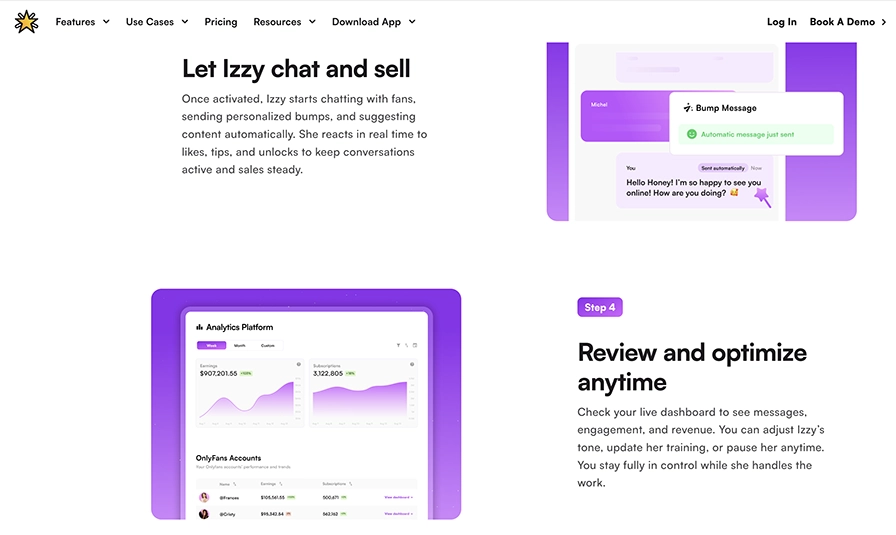
NEO Agency reportedly manages about 70 creators with half using FlirtFlow, with the AI engaging subscribers in conversation to extract more spending. We explored this phenomenon in detail in our OnlyFans AI chatbots guide… and it’s only accelerated since then.
The kicker is that AI chatbots are now starting to replace the low-wage overseas workers – often based in the Philippines – who previously impersonated creators in DMs. So the workflow goes: fan thinks they’re talking to the creator → fan is actually talking to a Filipino chatter → fan is actually talking to an AI trained on that chatter’s conversation logs.
If users only knew who they were actually talking to, the entire system might crash.
(Or maybe they simply don’t care?!)
To be fair, OnlyFans’ terms of service technically prohibit fully automated bots that impersonate creators… “without human oversight”.
But that last caveat is doing a lot of heavy lifting in terms of how they police it.
In practice, the industry has settled on a grey zone where AI “suggests” replies and humans approve them with a single click. Whether that meaningfully qualifies as human oversight is… debatable. But it’s what we see happening across the board.
For creators, this raises an obvious question: if AI can do the messaging that generates 60% of your revenue, what exactly is your value proposition?
It’s the same question facing adult industry jobs across the board as AI capabilities expand. And for fans spending money on what they believe is a personal connection… well, that’s a conversation about informed consent that nobody in this industry seems eager to have.
The 20% Question (and Why It Matters More Now)
OnlyFans takes 20% of everything.
You don’t get to become the most profitable business in the world, per employee, without being a bit of a greedy bastard.
That means: every subscription payment, every tip, every PPV purchase, every paid message…. 20% of it is going straight to the house. That’s the deal, and it’s been the deal since the early days.
For a long time, creators accepted it because OnlyFans was the only game in town with serious audience scale. But there are small signs that we might (eventually) see some disruption:
OnlyFans Fees vs The Competition
- Passes charges just 10% and offers built-in CRM, anti-screenshot technology, and multiple revenue streams including paid calls and a digital marketplace
- Fansly matches OnlyFans at 20% but adds tiered subscriptions and content previews that fans can pay to reveal
- Fanvue takes 15% for the first three months (20% after), offers virtual meet-and-greets, and – crucially – allows immediate withdrawal instead of the 4-5 day hold OnlyFans and Fansly impose
- JustForFans retains only 15% of creator earnings
The maths on that 10% difference between OnlyFans and Passes is not to be sniffed at.
If you’re a creator earning $5,000/month in gross revenue, OnlyFans takes $1,000. Passes takes $500. That’s an extra $6,000 a year in your pocket – which, for a mid-tier creator, could be a major drawing card.
So why hasn’t everyone switched?
Three reasons: audience, audience, and audience.
OnlyFans has 377.5 million fan accounts. Passes, Fansly, and Fanvue combined don’t come close. They are not even operating on the same planet.
And the platform “network effects” are real – most fans simply don’t want to create accounts on four different platforms, and creators go where the fans are.
Some savvy creators are hedging their bets by working across multiple platforms simultaneously, but that comes with its own overhead (although with the risk of getting de-platformed, it’s something we would certainly recommend!).
With Radvinsky’s death and the pending Architect Capital acquisition, the competitive dynamics could shift.
New ownership means new strategy, and new strategy could mean anything from fee adjustments to content policy changes. We’ve seen this film before… remember August 2021, when OnlyFans tried to ban sexually explicit content entirely?
What a clusterfuck that was.
The little experiment (or misadventure) lasted six whole days before the backlash forced a reversal, and the trust damage has lingered for years.
Will New Ownership Change The OF Game?
We’re just hours after the event, but Radvinsky’s death throws the Architect Capital deal into uncertain territory.
The San Francisco-based investment firm was reportedly in exclusive talks to acquire a 60% stake in OnlyFans at a $5.5 billion enterprise valuation (roughly $3.5 billion in equity plus $2 billion in debt).
Architect believes OnlyFans has a path to going public in 2028, with internal projections putting annual net revenue at roughly $1.6 billion…
But those talks were reportedly with Radvinsky himself.
His 75% stake now passes to his estate – his wife Katie Chudnovsky and their children – and estate negotiations are a different beast entirely.
It’s entirely possible the deal goes through largely unchanged. It’s also possible it gets renegotiated, delayed, or it could even collapse altogether – it’s very difficult to say at this point.
For creators, there has been plenty of talk over what to expect: does new ownership change anything about the platform they rely on?
History suggests it might.
Radvinsky, whatever you thought of his background (he founded MyFreeCams in 2004 and faced lawsuits from Amazon and Microsoft over alleged spam campaigns in his early ventures), understood the adult industry from the inside out.
He knew that OnlyFans’ value was its creator base, and that alienating creators meant killing the golden goose… especially in some a competitive market.
A private equity firm with an IPO timeline has different incentives.
Public markets are notoriously squeamish about adult content. The pressure to “clean up” or diversify away from explicit material – the same pressure that nearly destroyed the platform in August 2021 – will intensify if an IPO is genuinely on the table.
We think this is extremely unlikely given that OF is basically dependent on its adult creators to drive the existing numbers.
But if you’re a creator whose livelihood depends on OnlyFans, you should be paying very close attention to who ends up holding the keys.
The Model Perspective: How Can You Compete?
If we look at what all these numbers actually mean for the people creating the content, the reality is pretty stark.
With 4.63 million creators competing for attention, the pressure to produce more, post more frequently, and push personal boundaries further is absolutely relentless.
Mental health professionals who work with OnlyFans creators report epidemic levels of burnout, anxiety, and depression. The cycle is grimly predictable:
- creator launches with enthusiasm
- initial earnings are exciting
- growth plateaus
- creator escalates content to maintain engagement
- boundaries erode
- burnout hits
- creator quits or limps on at reduced capacity
The “always on” nature of the platform makes it so much worse.
Unlike traditional adult production (where you shoot a scene and it’s done), or even cam shows, OnlyFans demands near constant engagement.
Fans expect regular posts, prompt DM responses, personalised content, and the ongoing feeling of intimacy and access. If they don’t get it from you… no problem… they’ll get it from somebody else.
It’s less like being a performer and more like being in thousands of simultaneous relationships, each one requiring a fresh dose of maintenance, makeup and smiles.
The economics make it almost impossible to take a break unless you are a top tier performer.
Unlike a salaried job, OnlyFans income hits the skids from the moment you stop producing. Take a week off and your subscriber count drops. Take a month off and you’re essentially starting from scratch. The way the algo works – such as it is – the rewards are for consistency, and the market rewards novelty.
For the 40% of creators earning under $10/month, the burnout might be a sweet mercy.
They’ll probably quit before it gets to them.
It’s the squeezed middle tier that grinds the hardest – the ones earning enough to feel committed but not enough to feel secure – and it’s a grind that can go on for years.
Some diversify into other platforms for selling nudes or explore selling homemade content through alternative channels – literally anything to avoid putting all their eggs in the OnlyFans basket.
A Platform Success Story
Most models would bite your hand off for just 0.01% of what Sophie Rain earns in a year, but the reality is this:
OnlyFans isn’t a creator economy success story. It’s a platform economy success story.
The platform itself is staggeringly profitable.
$684 million in pre-tax profit on $1.41 billion in net revenue. That’s a 48.5% profit margin. Radvinsky personally was worth $4.7 billion at the time of his death… built almost entirely on the back of OnlyFans, which stood head and shoulders above his earlier success stories like MFC.
But of the creators who generate that value, the median models earns $180 a month. 73% of all earnings go to the top 10%. The Gini coefficient is worse than any country on Earth.
This is what any aspiring model must understand to avoid massive disappointment.
This isn’t unique to OnlyFans, of course.
Spotify has the same problem (the top 1% of artists earn 90% of streaming revenue). YouTube has the same problem. Fuck, the entire creator economy is built on a model where platforms extract reliable revenue from the aggregate while individual creators face wildly unequal outcomes.
But OnlyFans is arguably the most extreme example, because the content being created is among the most personal, intimate, and psychologically demanding work imaginable.
When Leonid Radvinsky died this week, a billion-dollar empire lost its architect. The eulogies will focus on what he built – and it was, by any commercial measure, extraordinary. Under his ownership, OnlyFans grew from 350,000 creators to 4.63 million, and revenue increased from $59 million to $7.22 billion.
But the legacy isn’t just the platform.
It’s the economic structure the platform created… one where a handful of people get spectacularly rich, and millions of others provide the content, carry the stigma, and split what’s left.
Do you create content on OnlyFans – or have you considered it?
We’d love to hear about your actual experience with earnings on the platform. Drop us a comment below, or get in touch – especially if the numbers in this article don’t match the marketing hype you were sold!