It appears that Pornhub has found a narrow path back into the lucrative UK market.
This time, with a little help from the iPhone in your pocket…
If you’re an eligible adult using iOS 26.4, Apple is now able to confirm that you fall into an “adult age group”, meaning porn giants like Pornhub can wave you through without the faff of on-site age verification.
The good news: this means – potentially – no more awkward selfies with your driving licence while your boner disappears in a tangle of red tape.
Device-level verification is something that we’ve talked about on AdultVisor for a while now, and though it may sound like a small technical change, it really isn’t.
Certainly not from the porn industry’s perspective.
The UK has spent years wrestling with the logistics of age verification, and it’s fair to say this year’s mic drop of the Online Safety Act has gone down like a lead balloon in adult business circles.
(To the surprise of absolutely nobody, VPN use is through the roof.)
Apple’s approach has plenty of upside, but it also comes with several rather large strings attached.
For one thing, Apple would stand to become a gatekeeper over the door to legal adult content. Plenty of adults are outside the iOS ecosystem – and will need a different way in. And yes, it raises some questions about what happens to devices that are shared by multiple users.
From a data safeguarding perspective, we think this is a positive step. Pornhub learning your age category via Apple is much better than handing a random third-party interloper a copy of your passport on a page that may (or may not) be legitimate.
So how would it work in practice?
How Would Apple Age Checks Actually Work?
There’s plenty of confusion here.
To be clear, Apple isn’t emailing Pornhub or RedTube a scan of your passport like some all-knowing demigod in charge of your next fap.
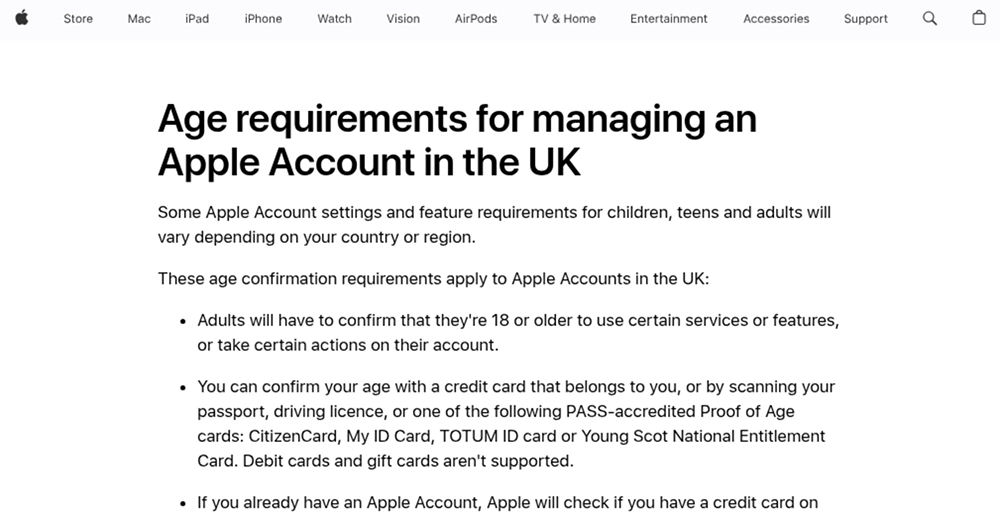
If we look at Apple’s current UK support guidance, a user can confirm that an Apple Account is 18-plus using a personal credit card, passport, driving licence or PASS-accredited proof-of-age cards. From what we’ve seen, debit cards are not good enough to pass this test.
If you leave the account unconfirmed, nothing bad happens – the iPhone continues to work. But Apple switches on the default Web Content Filter and Communication Safety, so you’ll need to confirm your age before meddling with those settings.
Once the account status exists, Apple’s Declared Age Range framework comes into play. This allows a “participating service” to request an age band or a category as defined by local law.
The response that follows will typically include how that status was established… and whether the user qualifies for an age-gated feature… like access to a porn site.
The crucial bit is that a site should, in theory, be able to determine that you are old enough to access it without receiving the actual ID, or forcing you to jump through yet another round of age verification roulette.
While it’s good to see that the Apple-confirmed route is live, we still haven’t seen enough to claim that every porn site can simply prod your iPhone for a 18-plus entry pass. Early days, yet.
Pornhub’s Privacy Woes
The adult industry has advocated, for a long time, that verification should be dealt with at the device level, and it’s not hard to see why they’d be keen to shed this red tape from their in-trays.
Aylo, Pornhub’s parent company, has been one of the loudest proponents of device-level age checks.
In February 2026, Aylo pushed the red button and restricted UK access for new unverified-users across Pornhub, YouPorn and Redtube.
While existing users with verified accounts were unaffected, for everybody else, the site was completely inaccessible without a VPN.
(I remember joking with friends at the pub that if somebody checked our IPs, it’d look like the United Nations had parked at Table 24. Wasn’t really joking though!)
After going dark in Blighty, Aylo put forward a very public argument that Britain’s site-by-site rules exposed adults to privacy risks and pushed viewers towards less regulated corners of the web.
It’s the default privacy argument of the adult industry…and, to us at least, it makes a lot of sense.
In the months following the law change, we had this absurd situation where the largest porn sites – and those that did the most to obey the rules – were the ones that the very users the government was trying to “protect” would steer clear of.
Obviously, those users would get their porn kicks elsewhere. A boner doesn’t just disappear.
It floats to darker parts of the web.
Not enough time or consideration was given to the significant risks of data breaches that the roll-out would introduce.
Most notably, that the age verification step itself – submitting your ID to a third party site – could be targeted by malicious third parties, hijacked and used for blackmail, extortion, or as a cache of data to be sold on the black market.
None of this is to touch on the mercenary capitalist argument that porn audiences aren’t exactly known for their patience. Stick a lengthy form between a visitor and the video they came for, and many are going to split like they’ve heard the missus turning a knob on the bathroom door.
At the same time, it’s hard to feel too sorry for a massive entity like Pornhub.
I mean, it sucked up a massive chunk of the entire porn industry in the late Noughties – it’s not exactly a pauper.
But the trickle down economics are a factor, too. Performers and creators feel the squeeze through weaker discovery and less views – particularly those based in age-verification affected markets. And there are a whole bunch of sites, with less money than Aylo, that have had to pivot fast.
A reusable age status would certainly be a big help – it would cut some of that friction.
But Is This Actually Better For Your Privacy?
An adult site generally needs to establish one key fact:
Is this visitor old enough?
Exposing names and home addresses are rightly seen by users as an infringement of their privacy; an overstep from a porn site – this is always going to be the case when the service being accessed reveals something about your sex life, kinks or bedroom preferences.
And this is where repeated site-level checks are not fully trusted to serve their stated purposes.
Even if Pornhub never touches the actual passport, the user is right to think:
- Who is this outside verification company?
- How are they going to process my personal details?
- How safe is their data encryption?
All of this matters a great deal in the business of porn.
While it’s true that site-level verification can be handled responsibly, many of us are reluctant to put that theory to the test.
The big companies have precautionary measures in place. For example, keeping documents away from their own systems, using independent providers, and minimising how long information is retained. They also have much larger budgets to swallow some of the inevitable cost.
Ofcom’s guidance is flexible to the extent that it lets site owners choose which pain in the arse they’d prefer: you’ve got photo-ID matching, facial age estimation, open-banking checks, mobile-network information, credit-card checks and a myriad of other digital identity services.
(In our case, as a tiny piss-ant magazine, we chose scouring hundreds of pages and removing every last trace of a nipple to keep things SFW.) 🤦♂️
None of the above methods are plug and play in a way that isn’t going to absolutely nuke your traffic.
From the user’s perspective, each verification method has a different nuisance factor. Some methods feel seamless and almost invisible (once you accept their inevitability).
Others can feel like digitally emptying your pockets; like the naughty boy on the school step having to ask permission to step inside in his cummy trousers.
Would the Apple process improve matters?
Yes, it absolutely would.
Apple already controls your account details and handset.
While it would need some sensitive evidence to establish that you’re over 18, it’s a one and done deal. A limited age category means that evidence doesn’t have to follow you onto the porn site. You’re not showing your passport to a new bouncer every time you enter, right?
Fewer companies see it, and those sites receive a lot less data.
A binary device-level Old Enough? Y/N is infinitely better than what we have now.
It comes with the trade-off that Apple gets a bigger role in deciding how legal adult content is reached, yes, but if we’re being honest, could it really do a worse job than the existing framework?!
Likewise, porn sites may face becoming dependent on account rules and technical interfaces over which they have no control. A skeptic might argue that we’d be solving part of the privacy problem by giving an operating-system company another hand on the internet’s wheel.
And Apple hasn’t exactly proven itself as a horndog’s best friend.
Its nuanced history with adult apps and games could fill a separate article, preferably one read outside the App Store!
Will Your iPhone Become The AV Bouncer?

The idea of “verify once” makes all of this sound like a beautifully elegant solution to the age verification problem.
Unfortunately, the nature of real households may yet throw a spanner in the works.
There are various edge cases where the system has weak spots:
- A family iPad might sit under an adult Apple Account and pass between several users in the same house.
- A borrowed phone will have a valid age category that belongs to its owner… but not the person holding it.
Any adult site will also keep its legal responsibilities.
Apple tells devs to apply appropriate restrictions and comply with local law – it’s hard to imagine them agreeing to be used as some magic regulatory condom when liability is concerned.
In its 2026 report on age assurance, Ofcom says every existing age verification method leaves “some opportunity for circumvention”.
We’ve already hear rumblings of a possible VPN ban in the UK. In response to that, we say: surely fucking not.
(Thankfully, it has since been vetoed.)
Ultimately, if the direction of travel is towards layers of verification baked into operating systems and device makers – we can certainly get behind that.
The iPhone can carry one useful layer – even if it obviously can’t stop every determined teenager with a borrowed device (or the ability to sniff out sites belonging to unclassified age groups).
If you’re wondering what this means for non-iOS users, we’re still waiting, too.
The signs are that Android is heading towards similar territory.
Google’s Play Age Signals API can return age bands, including 18-plus, to Android apps, which might prove useful for the legions of unofficial adult apps it already houses.
The system has been expanded through 2026, but we haven’t yet seen a public UK announcement giving Android users an equivalent Pornhub entry pass – and FWIW, Google’s doc are still heavily focused on apps rather than in-browser activity.
For this idea to have legs, it has to work on all devices – not just some. It would need to work across browsers, phones and desktop systems. That sexy interoperability will decide whether device age checks become a standard… or just some extra Apple feature to benefit a small few.
After years of covering the age-verification fight, our view is pretty simple: the adult site should learn that you’re an adult and as little else as possible.
Pornhub’s iOS return shows that this can work on a major service. It reduces the need to repeat sensitive checks, removes some truly boner-killing friction and gives the site a narrow answer instead of a bundle of identity data.
That’s a decent improvement.
Would you trust Apple with the age check, or would you rather keep the existing AV system?