Ksshhhhkkk… bwooiiinng… ding-ding-ding… whooooosssh…
What the hell is that noise?
If you’re under the age of 30, you probably don’t remember the gloriously suspicious siren wail of the 56K handshake.
For me, it’s seared into my childhood, followed by my mum barking: “You’ve got fifteen minutes!”
Before I drown in the nostalgia, we’re going to attempt something a little daft – but hopefully quite interesting.
We’re going to dust down the time machine, set the dial to the year 2000, and let that screech carry us back one more time, to answer the question:
What would AdultVisor be talking about at the turn of the century?
In 2000, the web was just a few sweet years into going mainstream. But the adult industry was already balls-deep in the thick of it, grinding away, working out how to charge people for things online while most “proper” businesses were still debating whether they needed a website.
The Dotcom Bust was about to leave many of those suits with nothing but sock-puppet mascots and empty office chairs.
But porn was actually turning a profit.
The adult web, in 2000, was a very different beast to the one we cover today.
This was seven years before the seeds were planted for Pornhub. There were no tube sites, no free HD streaming, and even social networks were yet to make a dent on forums, bulletin boards and IRC.
Instead, we had trusty link lists, postage-stamp thumbnails, password networks and paysites charging $24.95 a month for the privilege of watching a two-minute clip trickle down the phone line over the course of an evening.
So what major sites did the adult web consist of in 2000?
What Were The Top Porn Sites In 2000?

It’s important to understand the context:
By June 2000, just 3% of American adults had broadband at home… compared to 34% on dial-up.
Getting online was one thing, staying online long enough to download chunky video files was another matter altogether. Much of the adult web was thus shaped by the limits of bandwidth – and so, many viewing sessions would be restricted to a single video, or a single gallery set.
The gatekeepers that controlled discovery – by curating links – were much more influential during this time.
The Hun’s Yellow Pages

The Hun is one of the few 2000-era destinations that is still around today, and even more remarkably… it looks very similar, albeit with text gallery links swapped out for image galleries.
This famous old porn resource started life as a hobby. Its creator, a Dutch computer science student known simply as Patrick (the “Hun” nickname came from his demo-scene days), began publishing links to various free porn collections he’d spotted (in chatrooms and forums).
Because it was a directory of free stuff… he coloured it yellow. Hence The Hun’s Yellow Pages.
The site grew fast. Ridiculously fast. His ISP famously cut him off for burning through too much bandwidth after The Hun pulled over 100K visitors in its first month.
Some friends running a Dutch hosting company stepped in, hosting the site in exchange for a split of the front-page ad money – which, as you can see above, was fairly primitive back then (“ENLARGE YOUR PENIS!”).
By 2000, the format was well and truly locked in. Every day he would publish a fresh, date-stamped list of one-line text links to galleries submitted by paysite webmasters, up to around 100 a day, all checked by hand.
It would have been bandwidth suicide back then to include images, so the drops were pure blue text links:

Horny punters would load the yellow page, scroll today’s list, click an appealing description, and a new window would open on a gallery of thumbnails, stacked with 90’s era porn snippets.
If you remember using dial-up back then, you’ll be familiar with the grand pixel reveal.
Each thumbnail would slowly reveal itself… the white screen would slowly morph into NSFW content that felt downright illicit on a blocky 90s monitor.
Then you’d get kicked off because somebody needed to use the phone!
Where is it now? The Hun is still live, still disgustingly yellow, and still visitable today. In fact, it’s run by the same family… with Patrick’s son now doing most of the heavy lifting alongside a small team. Today the homepage is a gallery of thumbnails intertwined with affiliate offers and banner ads. It will never be as popular as it was during the porn web’s formative years… but it’s certainly a trip down memory lane…
Persian Kitty
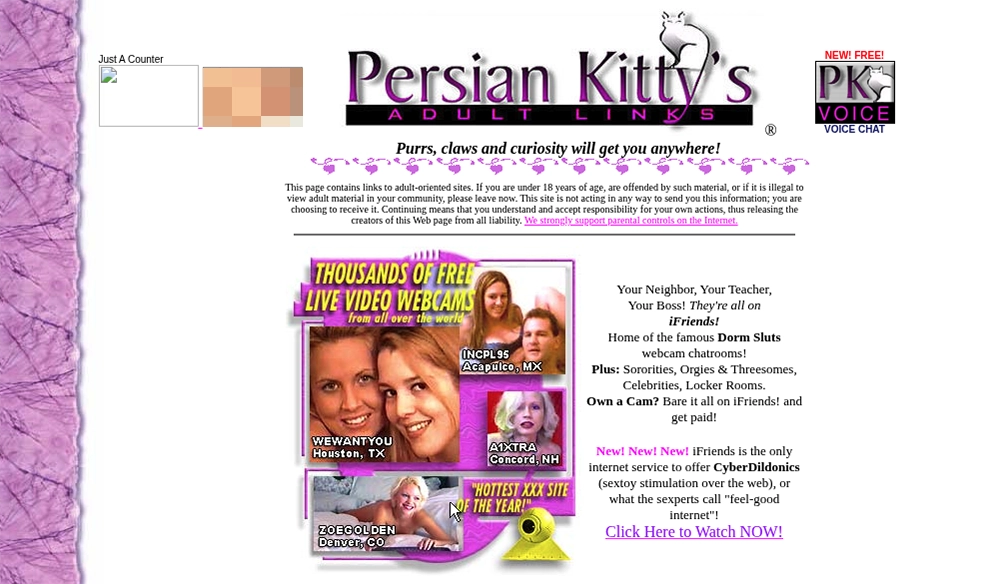
When you think of the earliest online adult pioneers, you probably don’t think of a former accountant mum with two young sons… and a bunch of time on her hands.
Persian Kitty was the brain child of Beth Mansfield, a burned-out accounting manager who took a few months off work to experiment with a rather unusual side-quest.
She put up a little personal web page and got hooked on the idea of strangers visiting it at all hours.
So she wondered how much traffic she could pull. And what would bring the punters in?
It just so happened that the top sites on the hit counters of the day were all adult link lists, so she built one. It went live on 1 October 1995, and she called it Persian Kitty’s Adult Links because that’s what her “cyberfriends” already called her. Wired later claimed the name came from her cat(!).
The site itself, similar to The Hun, was a long, alphabetical list of porn sites offering at least a few free pics, plus a cheeky “Purrfect Pose of the Week” to keep people coming back. Lew Payne, a programmer who Metro Silicon Valley reported helped run and vet the site, summed up the era perfectly: “People spent 30 minutes to download an eight-megabyte MPEG which lasts 45 seconds.”
Yes…
Thirty minutes. For 45 seconds.
Compare that to your modern-day porn GIF site experience, and it’s no wonder we have an ADHD problem.
The money on Persian Kitty came almost exclusively from banners. A listed site first offered to cover her $400 monthly server bill in exchange for an ad, which quickly became proper flat-fee advertising. An outfit called WebPower bought the top banner in February 1996 and never relinquished it.
By July 1998, Forbes reported Persian Kitty was raking in around $125,000 a month, with a healthy profit margin (costs of around a quarter). Mansfield turned down an anonymous $10 million buyout offer, and claimed she was fielding several more every week. There was even a deal for a Persian Kitty print magazine.
Not bad going for a link list.
Where is it now? Persian Kitty’s domain is still active, and still promising free porn sites “updated daily”… but it’s a relic of what it used to be, presumably taken over by a new owner and pushing cam affiliate links under a 2022 footer.
The TGPs
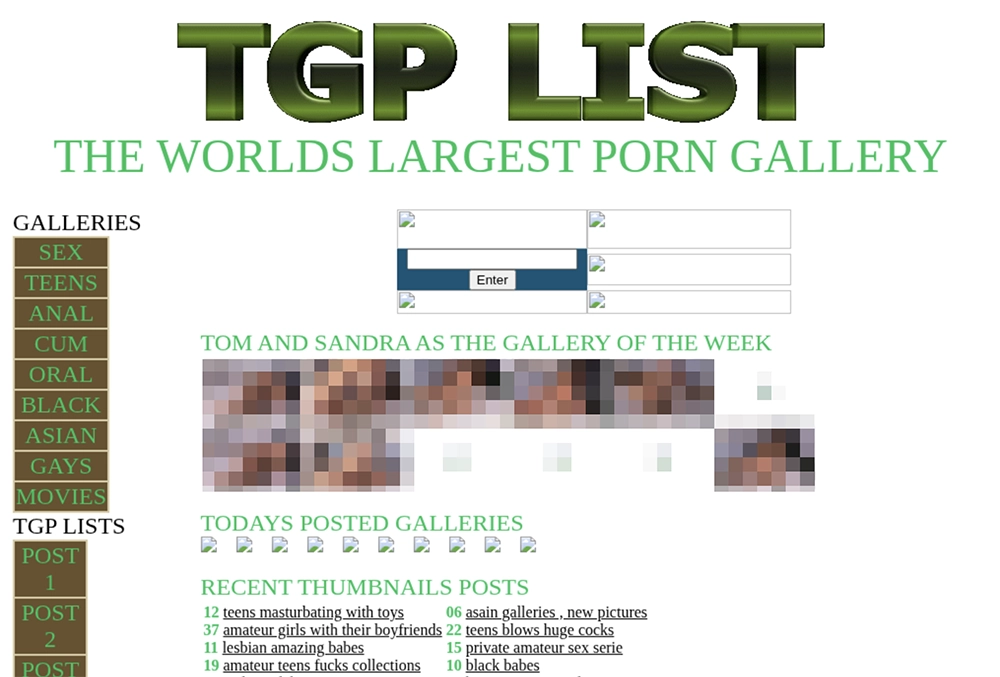
One of the reasons for Persian Kitty’s eventual traffic decline was the rise of a competing business model.
A TGP, short for thumbnail gallery post, was a page made of tables of tiny thumbnails, each one linking to a sample gallery hosted by a paysite. You’ve probably seen these in the wild: they’re still a thing.
Every gallery would carry an affiliate ID in its URL. Around them sat a whole ecosystem of link lists, “top lists” ranked by the traffic they sent, and the notorious “circle jerk” pages whose links didn’t go where they promised.
For the surfer, it was a hall of mirrors.
Click a thumbnail, land on a gallery, click a pic, land on a “tour”, click anything, land on a join page. Try to close the window and, as Forbes noted back in 1999, many of these TGPs would unhelpfully spawn another porn site on the way out, with the referring site taking another cut of the cash.
Close that one, and two more appeared.
(If you never played porn-popup whack-a-mole on the family PC, the closest comparison I can think of would be if you attempted to watch an illegal sports stream in 2026. IYKYK!)
Behind the TGP curtain, it was a pure affiliate economy. The Wild West days.
As early as 1998, Forbes reported that Seth Warshavsky’s IEG alone was paying around $450,000 a month to 1,400 referring sites.
And as an affiliate marketer myself, I’ll add: the free-site era was the adult industry’s very first apprenticeship. A huge chunk of the people still running this business learned their trade building galleries for TGPs, and then blasting ads through networks like PlugRush. As shit as it all was, they were mighty profitable.
Where is it now? TGPs still exist but they (understandably) are much less “effective” on the modern porn consumer. A handful of the old names are still ticking over, and sponsor-hosted galleries are still part of plenty of affiliate programmes. It was the arrival of tube sites in 2006–07 that really popped the balloon.
Adult Check

I would argue that this is the biggest name in 2000-era porn that most people have never heard of.
(Or simply erased from their memories…)
Adult Check wasn’t actually a porn site at all. It was a password.
In effect: a porn passport.
Launched in 1997 by Cybernet Ventures, founded by Laith Alsarraf and Vardan Sarkisov, it was sold to the world as age verification… (see how we’ve gone full circle?!).
While officially it was a response to US laws trying to keep kids away from online porn, under the hood, it was one of the cleverest bundling businesses the adult web has ever seen.
As a punter, you’d land on a “free” site from a link list – or a TGP. The resulting splash page would tell you that the explicit content required an Adult Check ID, again… much like modern age verification gateways.
So, the horny bastard that you were, you’d hand over your card details, and cough up a nominal fee of around $19.95 for a year. A PIN arrived moments later. Using that pin, thousands of “AVS sites” across the web would wave you straight through without a second glance.
What’s interesting about this model is how aligned the incentives became.
Webmasters could install the Adult Check script for free and they would earn a commission on every PIN sold via their site. The sites became secondary to the age verification itself. A later court ruling noted that Cybernet typically kept about half of each fee, with the rest passed to the third party site.
Thousands of tiny “mini paysites” emerged out of nowhere purely to sell those PINs.
In 1999 the LA Times reported that Adult Check was “guarding” around 50,000 sites with more than 3 million paying customers. By 2001, Forbes counted roughly 4 million customers and 400,000 sites; all of this run from an anonymous former plumbing-supply warehouse in the San Fernando Porn Valley.
It was estimated that, at peak, there was $320 million a year in membership subs pouring through the system.
Adult Check passwords were arguably the most-traded currency on password-swap sites. Shared PINs would be zapped within minutes, but the swapping continued at a relentless pace.
Where is it now? Long gone. AC’s decline started with a 2002 court injunction, which forced Cybernet to actually police its network. Visa’s chargeback caps in late 2003 forced Adult Check to cut thousands of affiliates down to just 350 “top producers”, and it was downhill from there. The company was dissolved in 2011.
Danni’s Hard Drive

The more you look at these early adult web success stories, the more you see echoes of what was to come.
In the case of Danni’s Hard Drive, we see the earliest emergence of what would become the OnlyFans economy.
Danni Ashe was a nude model and dancer who’d been hanging around Usenet adult newsgroups in the mid nineties. By July 1995 she had built her own site as one of the earliest “fan club” concepts. Traffic followed hard and fast, and her servers soon buckled, so she got her own machine, jokingly calling it her “hot box”.
The paid members’ area became, inevitably… The HotBox.
Danni’s content was exclusively softcore. There was no hardcore sex, just a very effectively marketed world of models, galleries and personality… with Danni placing herself front and centre.
By early 1997 the LA Business Journal tracked more than 15,000 subscribers paying $9.95 a month for access to her site. This was in addition to a primitive webcam service where members could book live video chat with models at $6-7 a minute.
In 1999 Danni pulled a stunt that’d make any modern growth hacker weep: the “Boob Bowl”, a live event during the Super Bowl halftime show. Wired reported it boosted subscriptions by a staggering 50%.
By September 2000, The Register reported around 27,000 subscribers at $19.95 a month – all requiring an operation of 42 staff to keep things ticking over.
That August, Guinness had named her the “most downloaded woman on the internet“.
Unlike many models of that time, however, she was getting paid by the bucketload for her content.
Ashe said the business made $6.5 million the previous year, but that its fastest-growing line was actually selling its own streaming, hosting and billing tech to other companies.
Where is it now? Ashe sold up in 2004 and stepped away from the public life. In November 2006, Penthouse Media Group bought Danni.com’s parent companies for $3 million. Today, Danni.com is still online but there’s no sign of the original star – it continues as a subscription site, billed as the “original website” of Danni Ashe, but linked into the Penthouse empire.
CyberErotica
The adult web has long been seen as a cowboy’s playground: pretty much anything goes.
The truth is that the adult web we see today looks positively virginal compared to what existed in the early 2000s.
One of the companies that became infamous for pushing boundaries to the ethical limits was CyberErotica. This is the notorious paysite that turned “free” into an art form… and eventually into a federal case. Along the way, it became so popular that it was even turning out its own porn parody albums:
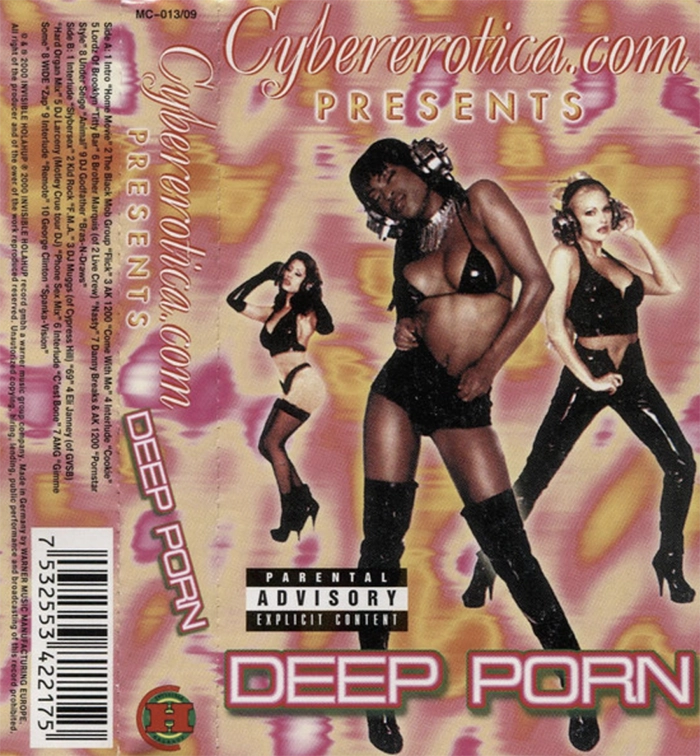
The operator was Voice Media, a Nevada company run by Ron Levi and Paul Lesser, which contained a stable of sites including: cybererotica.com, FF5.com and xxxpassword.com.
Levi is widely credited with helping to invent the modern porn affiliate programme (on behalf of AdultVisor, thanks Levi!). His early FastCash scheme paid webmasters to build free mini-sites that funnelled surfers to the paysite, a key step that transitioned the industry from paying for clicks to paying bounties per signup.
So what did it feel like to land on one of his sites in those early days?
Well, if the FTC’s complaint is anything to go by, we’d say: a bit like getting smashed in the head with a rusty spanner.
You’d see a banner screaming “100% FREE MEMBERSHIP CLICK HERE!” linked to a signup page which promised a “1 Week Membership – Free!!!”, renewing at anywhere from $19.95 to $34.95 a month.
The site asked for your card “to verify that you are of legal age”. Then, the FTC alleged, it billed you a month straight away, even if you cancelled inside the week.
The rebill industry achieved peak notoriety in the later part of the 2000s – and it wasn’t just in adult circles, açai berry weight loss pills, anybody?!
Voice Media settled with the FTC in 2001 without admitting wrongdoing. The same year, eWeek ranked it among a handful of operators said to control the majority of adult traffic, also noting CyberErotica had cut its signup bounty from $50 to $40 – one of the earliest examples of how affiliates would soon become the industry’s whipping boys. Some things never change!
Where is it now? CyberErotica faded from the industry through the 2000s as tube sites and bigger networks took over. Its affiliate arm, rebranded as CECash was run out of Curaçao for several years… but it now appears to be inactive.
Private.com
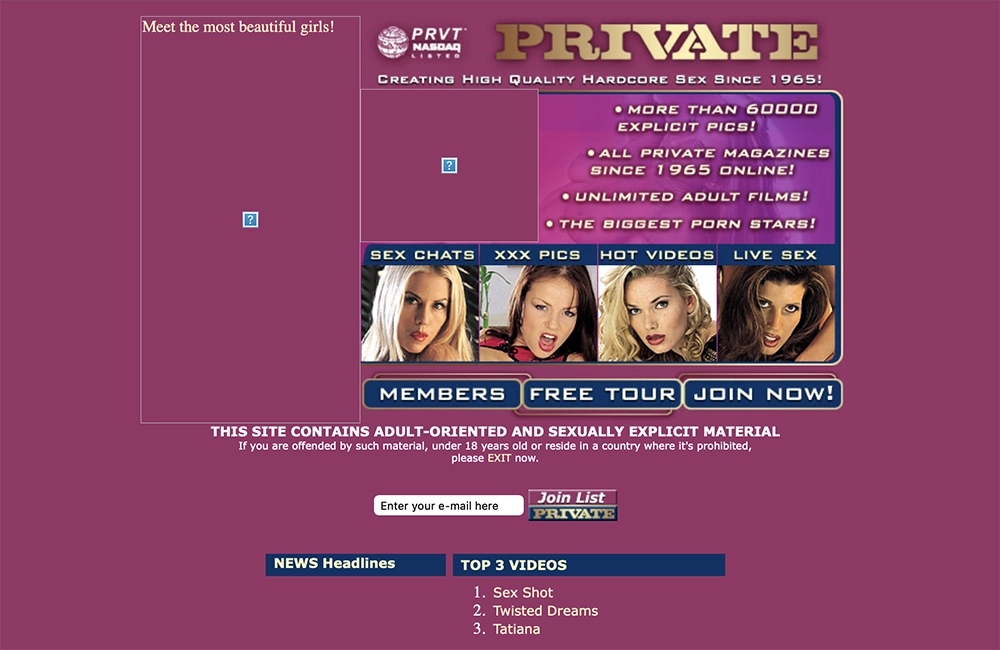
The early years of the online porn industry were not completely dominated by US brands. In fact, one Swedish-born studio quietly established one of the slickest paysites of the era.
Although if you looked at it today, you’d probably say “no thanks, mate”.
Private magazine was founded by Berth Milton Sr in 1965 and taken over by his son Berth Milton Jr in the early 1990s. By February 1999, Private Media Group had moved up the Nasdaq under the ticker PRVT, one of the very few hardcore studios ever to venture here.
Their flagship site, Private.com, launched in 1997 – one of the earliest examples of NSFW print venturing to digital subscription.
By March 2000, its annual filing described more than 10,000 active members paying $29.95 a month (or $149.95 a year), which worked out to around 2.4 million total visitors per month. The site itself had one of the earliest forms of an adult VOD library; a full searchable archive of Private magazines and video clip, and around 60,000 photos in total (enough to swamp the hardiest of internet connections back then!).
There were spin-offs too: PrivateCinema – for video on demand – and PrivateLive for live shows. It was very European… and very hardcore.
For 2000, the company reported $27.1 million in total revenue, with $5.3 million of that from internet sales, up 206% in a year. Many other studios were watching closely…
Where is it now? Private.com is still running as a subscription site, with the brand outliving pretty much everyone who built it. The operation got messy, though. Shareholders alleged Milton Jr had borrowed over $10 million from the company, leading it to go into receivership in 2011 – Nasdaq kicked it out. Around 2020, Private was snapped up by WGCZ, the company behind XVideos – and one of the largest porn companies in the world today.
ClubLove (IEG)
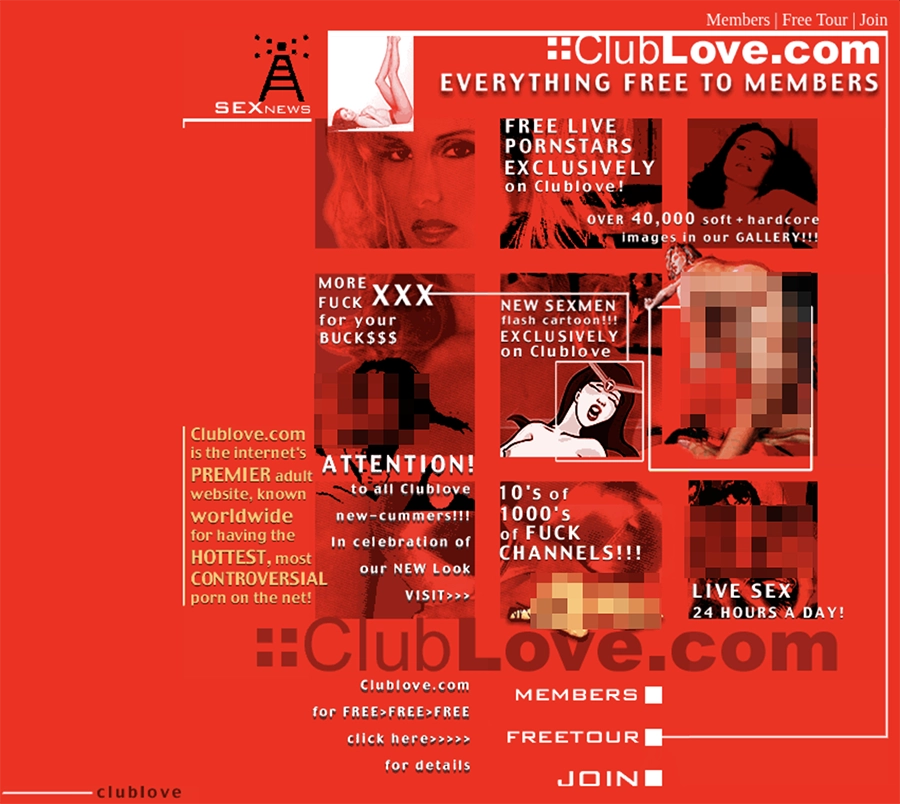
If every goldrush has a showman, the face of 2000-era porn was Seth Warshavsky.
Warshavsky came to the adult industry via a phone sex startup at the ripe old age of 17 – and he swiftly built Seattle’s Internet Entertainment Group (IEG) into one of the most famous adult brands of the late 90s.
Its flagship, ClubLove (check out that red monstrosity above!), made a name for itself with live sex shows at a time when consuming real-time video over the web was simply not on the menu for most Internet users. Most of us were lucky if the TGPs loaded before we got kicked off!
Wired’s 1997 visit to the operation, reprinted by its writer Frank Rose, is a fascinating read that highlights the earliest days of the modern webcamming industry.
The operation had four sets in a bare-bones downtown warehouse loft: a bedroom, a health club, a shower and a dungeon. The actual cameras were controlled by joysticks. Horny viewers could dial an 800 number to tell the performers what to do… and they’d do it. Taking their sweet time to maximise the cash.
Membership was $9.95 a month; a private live session cost $49.95 for 30 minutes. Sounds pretty reasonable by today’s pricing, but don’t forget the inflation! And the god awful video quality…
The video, Wired noted, was “tiny and fuzzy” on the 28.8k modems of the day.
But it was still live… and that in itself was a revelation back then.
Warshavsky claimed $44 million in 1998 revenue and $15 million profit, and talked about becoming “the Viacom of new media“. These figures were disputed by his fellow C-Suiters, with a former COO telling Salon the real figure was “closer to $700,000–900,000 a month”.
No small change, by any means. But the IPO that was promised never materialised.
IEG would later cause massive controversy by streaming the Pamela Anderson and Tommy Lee sex tape, which had been stolen from the couple’s home. It was one of several scandals that the company never recovered from.
Where is it now? By July 2000, a federal investigation had been launched into IEG’s finances, and the company was effectively finished. Warshavsky left the US for South East Asia around 2001. XBIZ reported that he had died in Thailand in October 2024 – he was 51.
iFriends
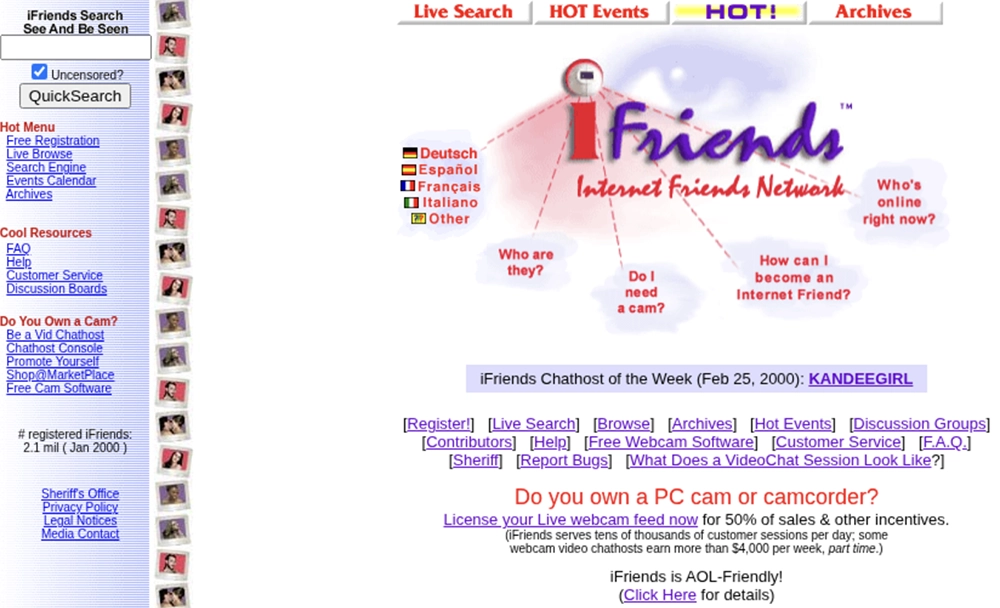
Seth Warshavsky wasn’t the only one to see the earning potential of live sex streamed online.
iFriends went live on Valentine’s Day 1998, run by WebPower, the same Florida outfit that held the top banner on Persian Kitty that we spoke about above.
While IEG was busy filming from a purpose-built studio in a Seattle warehouse, iFriends did something far more ambitious and important: it let performers broadcast from their own homes.
In many ways, this site was one of the true pioneers of the multi-layered adult webcam platforms. The other was VideoSecrets – still in operation as Flirt4Free today.
From a streamer’s perspective, it was a pain in the ass to broadcast live.
She would have to download a Windows broadcasting program and plug in an actual webcam. More importantly, she’d have to pray to the Internet gods that her connection would remain stable enough to deliver a show. Viewers would crawl through pages of live thumbnails, pick someone, hope the feed wasn’t broken, and then wait as the grainy feed emerged through a Java applet in the browser.
The video was hilariously bad compared to modern standards – small, jumpy and incessantly buffering. But nobody knew any better.
For many e-horndogs, this was the first time they’d interacted with a real person on the Internet.
Of course, iFriends wouldn’t stay king for long. Bigger, faster and far better-funded rivals were already on the horizon, and within a decade names like LiveJasmin, MyFreeCams and Chaturbate would leave the pioneers looking like dial-up relics.
Where is it now? iFriends ran for two decades, claiming more than 10 million members and 100,000 hosts over its lifetime. Ultimately, it couldn’t compete with the influx of well-monied rivals, eventually closing its doors in 2018.
Sex.com
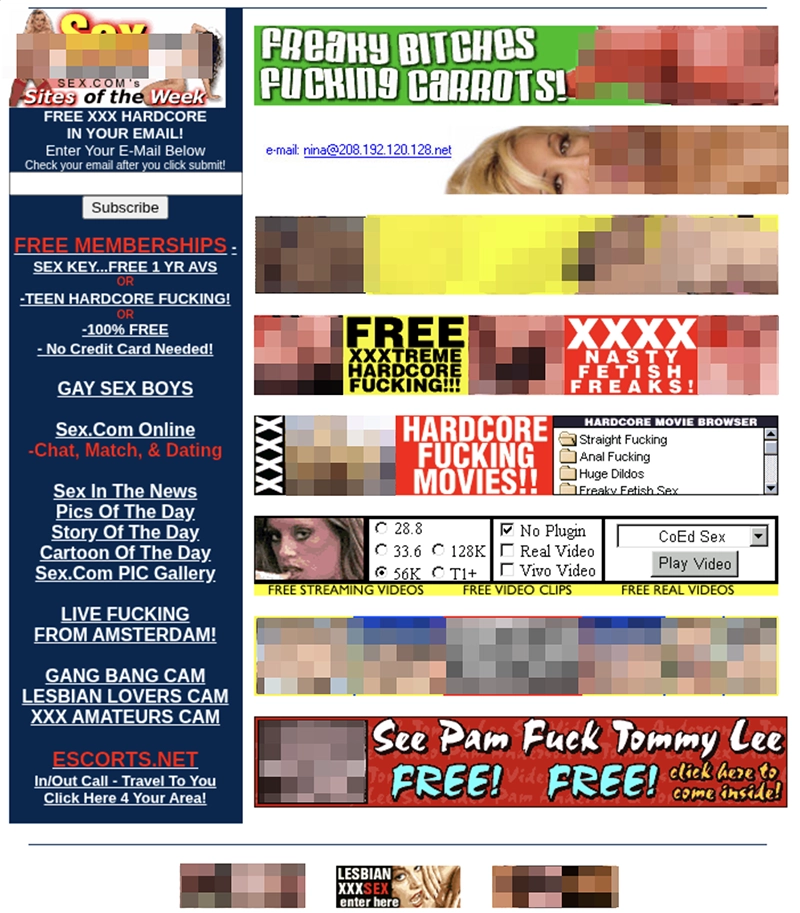
Finally, if we truly want to understand the adult industry at the turn of the century, it makes sense to end with a brand that was built around the one thing that mattered back then: a lucrative domain name.
Yep, in 2000, the most valuable porn asset wasn’t a studio or a library. It was three letters and a dot.
Because that’s how people actually found things back then.
Believe it or not, “sex” was the number one search term across the major engines, with Alexa estimating it was responsible for roughly one search in every 300.
Plenty of people skipped the search engine entirely and typed whatever they were looking for into the browser bar. Followed by .com.
Sex.com? Easy money, baby!
The lucrative domain actually belonged to Gary Kremen, who had registered sex.com for free with Network Solutions, the company that ran the .com registry back then. He never built anything on it. He was busy launching a little dating site… called Match.com.
Kremen would soon cross paths with Stephen Michael Cohen, a con man with a string of convictions who had once run a swingers’ club in Orange County. Cohen had seen the potential in sticking SEX in front of .com. In October 1995, he sent Network Solutions a letter, supposedly from Kremen’s company, saying it had “decided to abandon the domain name sex.com” and authorising its transfer to Cohen.
The letter was a forgery, but Network Solutions handed the domain over anyway!
Cohen didn’t need a studio or a single performer. He turned sex.com into a wall of banner ads and click-throughs, selling traffic to the paysites that needed it, and the site reportedly pulled up to 25 million hits a day from direct navigational traffic. In other words: people came straight to his site. No questions asked.
Estimates of what he earned range from $50,000 to $500,000 a month, depending on who you ask. Even at the low end of that scale, in the year of the Dotcom bust, a single address was earning more than most venture-funded start-ups ever would.
Ultimately, Kremen sued. In November 2000, a judge ordered the domain returned. In April 2001, Kremen was awarded $65 million, and Cohen promptly fled to Mexico. He was finally arrested in Tijuana in 2005, and Kremen spent years chasing money that he largely never saw.
Kremen eventually sold sex.com in 2006 for a reported $12 to $14 million – one of the most expensive domain sales ever at the time.
Where is it now? After Kremen sold Sex.com, the buyer later went bankrupt, and in 2010 the domain sold again for $13 million to an offshore company, Clover Holdings, in what was then (once again) a record domain sale. It relaunched in 2012 as a sort of “Pinterest for porn” and is still live today. The domain has never truly lived up to its premium name – but it always finds a buyer…
And Back To The Present Day…
So that was the adult web in 2000.
It had a little bit of everything… most of it in shit quality, and much of which we now look back on through the rose-tinted glasses of nostalgia.
(Nobody actually misses waiting half an hour for a 45-second MPEG. We miss the thrill of the hunt.)
Our Time Machine has seen yellow link lists, postage-stamp thumbnails, PINs bought for $19.95, joystick-controlled cameras in a Seattle loft, and a stolen domain earning more than most of Silicon Valley.
The strangest part is how little of it has actually gone away.
The adult industry never stops evolving, but strip away the HD video and the slick apps and the business model has barely changed at all.
Look closely and every big idea from 2000 is still here… just adapted to the future:
- The link list became the tube site.
- Danni’s Hard Drive became OnlyFans.
- iFriends and VideoSecrets became the cam industry.
And then there’s arguably the most delicious twist of all…
In 2000, age verification was a product. Cybernet sold it for $19.95 a year, and its founder even testified on the government’s side, defending a law that would have made checks like his compulsory.
Asked whether that would help, he didn’t exactly hedge, saying: “I think it’s pretty obvious it would help our business.”
A quarter of a century later, in many countries, it finally is compulsory. And the porn industry is once again battling it to the bitter end.
What were you surfing in 2000?
Let us know which of these brought back memories… and which legendary sources we’ve missed!