Back in May 2025, readers of the reverse-harem romantasy Darkhollow Academy: Year 2 stumbled across a paragraph that left author Lena McDonald in an almighty pickle.
Right there, in the middle of a tryst, the story abruptly announced that the passage had been rewritten “to align more with J. Bree’s style.”
J. Bree is a very successful – and entirely human – romantasy author.
In other words… the perfect prompt signal-bait.
What readers were looking at, of course, was a GPT editing breadcrumb, accidentally left in the finished manuscript where it would trigger an almighty shitstorm that eventually drew scorn and ridicule from the mainstream press.
The book soon disappeared from Amazon search results and later reappeared without the offending line. But the genie was out of the bottle. The author posted a note on her Amazon page explaining that she had used AI to help with editing because, as a full-time teacher and mother, she could not afford a professional editor.
A few months earlier, another romance author K.C. Crowne was caught red-faced with a similar incident, leaving the phrase “Thought for 13 seconds… Certainly!” fossilised in the text of another title called Dark Obsession.
You can almost taste the embarrassment:
“Ahh fuck nuggets.” 😳
Most of us can sympathise with copy-and-paste cock-ups, because most of us have used AI to cut the occasional corner, right? Right?!
The thing is, absent of leaving the prompt instructions in the text, there has always been an element of plausible deniability in AI-assisted work. This deniability has led to a massive surge in AI erotica flooding the Amazon marketplace.
The Watermarks Have Landed
So, the big news from the AI tech sphere…
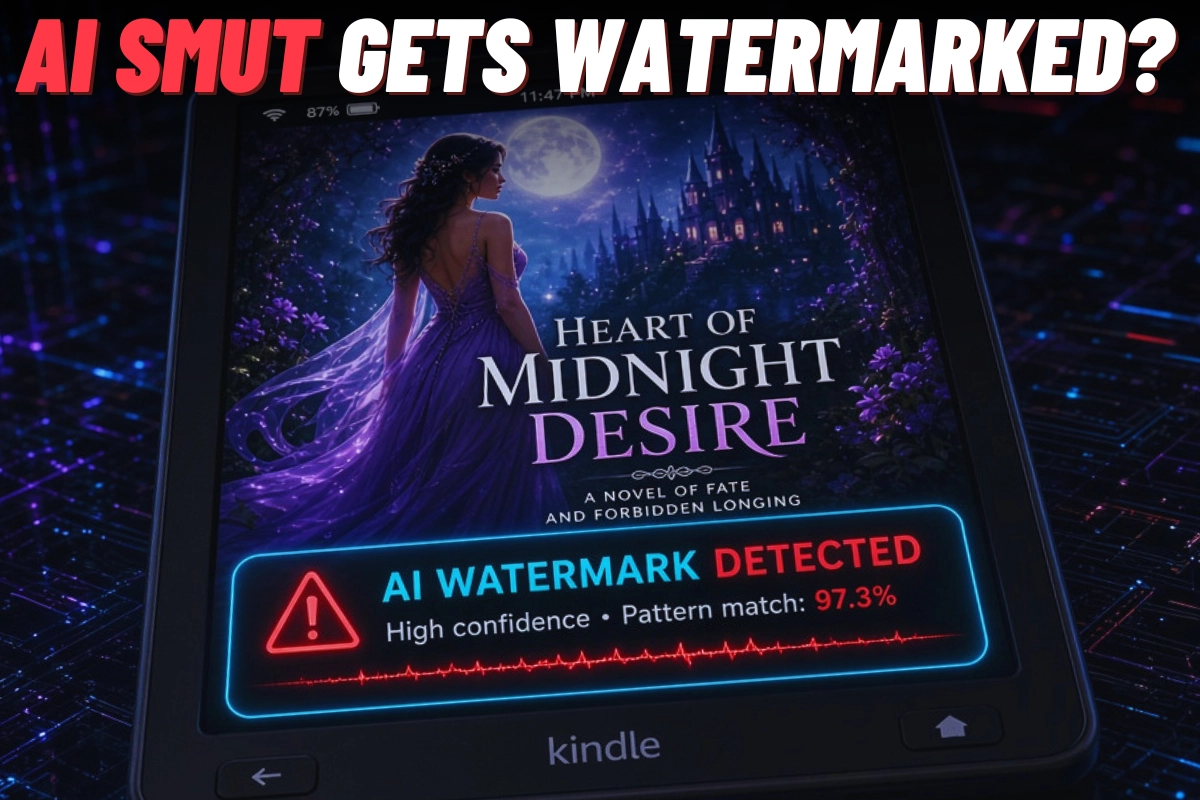
A lot of self-published authors are going to be feeling queasy this week after the announcement of all-new AI watermarks, driven by the EU’s Article 50 AI Transparency Act.
Anthropic has announced that new Claude models will embed an invisible statistical watermark in everything they generate. Whatever gets pasted from Claude will contain the watermark, and in theory, will be checkable.
Those who have been following this issue for a while will be aware that Google’s Gemini has been dabbling with similar provenance technology since 2024.
OpenAI, Meta, Microsoft and Mistral have all signed on to the same emerging European framework, so beating the watermark is not as easy as simply switching to a different LLM. Grok is the only hold-out so far, but surely not for long.
All of this raises a rather awkward question for one particularly lucrative corner of the publishing industry:
What happens to Amazon’s booming market for AI-assisted erotica when, for the first time, the books can actually be checked to see if they were created by (or with the help of) a LLM?
How The Controversial Watermark Tech Works
To understand the implications of watermarking tech, you have to appreciate that it’s a lot more sophisticated than stripping out emdashes and avoiding groups of three.
The watermark is a statistical analysis… not some hidden character, or an exotic bit of Unicode that gives the game away.
Here is an excellent explainer video (from three years ago) that successfully predicts the exact implementation of what companies like Anthropic have been working on:
(Computerphile is well worth following if these nerdy explanations interest you.)
To summarise, though, based on the thousands of tiny moments where a model could choose one word over another – “slope” or “hill” in the example – the choice is gently influenced by a secret key that nobody else can see.
In a long piece of text, across many such instances, the choice of words form a pattern. And so the pattern becomes a signature of whether a particular AI model wrote the code.
This approach is a version of SynthID-Text, the watermarking technique Google DeepMind published in Nature back in 2024. Incidentally, Google has already been using this tech inside Gemini… without a fraction of the backlash that Claude has received in the last week.
Anthropic says its watermark is invisible to readers, has no impact on cost or output quality and (critically) cannot identify the user that produced the text.
Some conspiracy theorists have hit the panic button over this last point, but in reality, watermarking AI content with a user ID is a completely different ballgame to simply assessing whether AI created it.
What the watermark can do is estimate the likelihood that Claude played a role in producing it.
Note:
Played a role. Not wrote the full text.
Anthropic has been quite explicit that the watermark will not reveal whether a full piece of text was generated by Claude, or whether the watermark is only present in a small passage.
(Which in itself has caused no end of outrage.)
“How dare Claude claim my work as its own?!”
If you ask Claude to fix a bunch of typos and correct some grammar, there’s not going to be enough words for the LLM to actually insert a statistical signal. But if you ask it for a complete rewrite of your vampire porn fanfic, that’s more than enough scope for a watermark to be embedded.
Now, imagine you’re already a successful erotic lit author on Amazon…
You’ve got a bunch of smash hit titles to your name. You’re reading this right now trying your hardest not to shit bricks at the thought of your previous work getting ‘outed’ over the coming weeks.
Previous Work Is Safe (For Now)
While Anthropic has said that older Claude models will receive the watermark tech “over the coming months”, there is no evidence that work created before August 2nd will have any kind of watermark present.
(Unless you committed a vast brain fart like the poor authors above.)
In a practical sense, there’s a small window where dropping back to last year’s model *might* allow authors to buy time and evade the model completely.
But we don’t even know what “evading the watermark” means at this point.
Anthropic says a detection API is coming, but it hasn’t released one and we’re not convinced that any such API will be truly public facing. To present an API-detection end point would give users the perfect sandbox to keep on editing and iterating “enough” to beat the tool.
Like a dystopian futuristic version of Man vs Copyscape.
Consequences For The Erotica Market
OK, so if you believe the public outrage, shit is about to get real if you rely on AI to assist with your work.
Or maybe it won’t. Who knows.
Why are we choosing to turn the crosshairs on erotica?!
Surely, there are plenty of other industries that would be much more susceptible to a big fat watermark?
(Like extortionately-priced legal advice, right?)
Erotica is one of those low hanging fruits of the publishing industry where the AI deluge hit hardest.
It relies on a famously high-volume, low-cost and heavily formula-driven.
Readers are usually looking for the next light breezy read, but they’re not expecting a Booker Prize winner.
Pen names are normal, and so the “author” was often already moonlighting as a brand/persona rather than a public-facing person. These days, a large chunk of the business goes through Kindle Unlimited, where authors are paid by pages read – around $0.0048 per page (latest April 2026 figures), which gets divvied up from a monthly global fund of more than $65 million.
Roughly speaking, a 300-page book, read from start to finish, might earn roughly $1.45.
That’s not much…. unless you have four hundred of them, spamming an entire category, max-planned on the latest smutty fiction generators.
When ChatGPT arrived, the marginal cost of publishing a book on Kindle collapsed to an almost trivial amount: the price of a flat white, plus your hours spent editing it.
An entire raft of adjacent tools followed, many of them marketed directly at romance and erotica authors with promises of immaculate drafts in a mouse click. Some of these tools take much of the creativity out of the brainstorming process – you literally just select your story by trope, tone and heat level. And that’s it – you’re an author!
Unsurprisingly, the numbers went crazy.
Imke Reimers and Joel Waldfogel published a NBER working paper which analysed roughly 10 million Kindle ebooks. For over a decade, releases hovered around 100,000 a month. By late 2025, you could almost taste the GPT – the number has almost tripled to more than 300,000.
Their AI detector deemed that more than half of 2025’s new releases contained AI-generated text.
It’s not that these books are known for doing tremendously well. In fact, it’s quite the opposite. They tend to fare badly with poor reviews and poor sales. But it’s a brute force numbers game.
Collectively, there are enough of these AI-titles to drown the market, steal away reader attention and reduce what the average human-written work earns.
So, we shouldn’t be surprised that many “human writers” haver greeted AI watermarks with a collective sigh of relief “Good riddance, and goodbye to the slop!“
Will Amazon Check For Watermarks?
At this point, nobody knows.
We’ve seen discussion on Reddit that watermarking will scupper the work of both AI slop artists and those who rely on “fair use” proof-reading and structural rewrites.
If it all gets labelled as “AI-written”, you can imagine the backlash.
Amazon has not announced any plans to use watermark detection, but we think it’s fair to assume that they would be paying very close attention to these latest developments.
For that, you need only consider the problem from Amazon’s POV:
It has a huge spam problem, and currently, only imperfect means of addressing it – like restricting authors to three uploads per day.
Amazon allegedly relies on automated pattern matching, various metadata signals and “suspicious upload behaviour” as a way of tackling undisclosed AI content. As for enforcement, it ranges from removing individual books to shitcanning entire accounts.
Currently, AI checker tools have rely on sniffing for statistical patterns and stylistic tendencies, but they are not perfect by any means.
Some would argue that many AI tendencies are recognisable to the point that a watermark is not even necessary. “It should be fucking obvious if you’ve got eyes”, goes the smart-ass reply.
We particularly enjoyed this reaction to the news on Reddit:
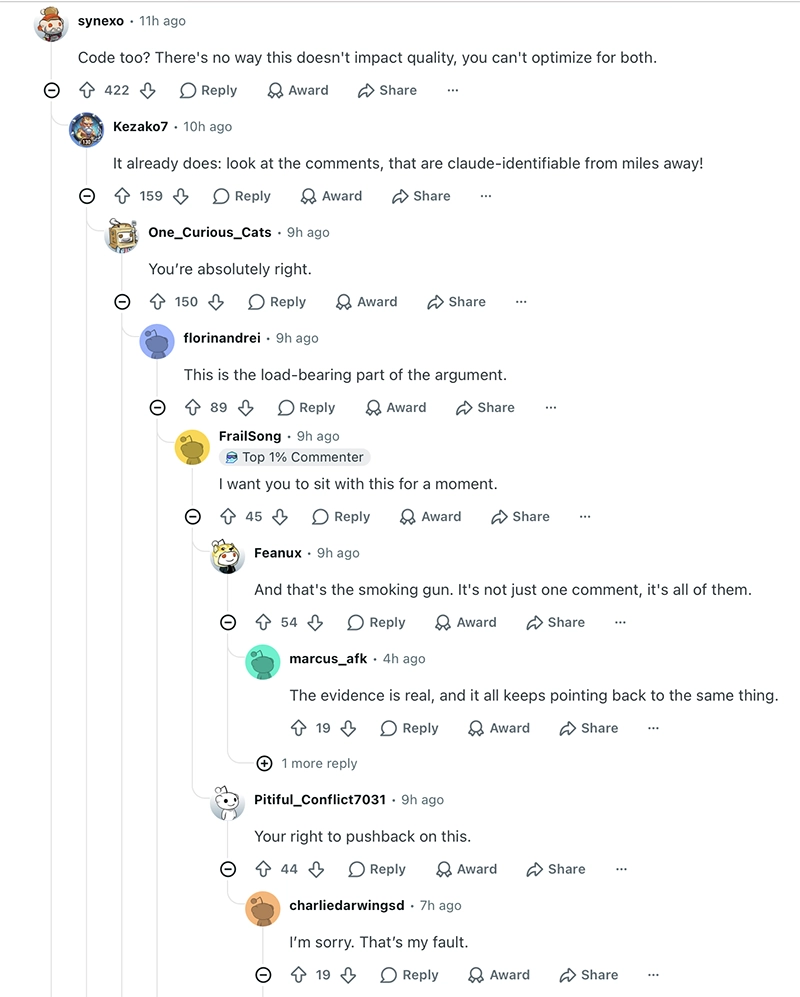
It’s funny, and it’s absolutely true that Claudeish and English are different beasts altogether.
But if you’re a “writer” whose work depends on slipping past Amazon’s algorithm, plausible deniability is going to be MUCH harder to attain if Anthropic turns up with a key and opens up the doors.
Imagine submitting to KDP…
The entire text gets digested by Big Tech and out pops the disclaimer:
“There is a 99.7% probability that this text contains Claude’s watermark.”
If I were running KDP’s operations, I’d have been banging on the doors for access to LLM watermark detection long before the EU made it a compliance issue.
And so, our bet is that some form of watermark checking enters the KDP pipeline within a year of provider detection APIs becoming available.
The obvious question is what Amazon would actually use it for.
One possibility is that it would be kept purely for internal enforcement:
- You declared no AI-generated content.
- The provider key says otherwise…
- Your account gets flagged and marked for manual review.
That feels like the obvious first step.
The second possibility is much more worrying to authors who rely on AI as part of their current workflows: what if Amazon exposes the information to customers?
“AI-generated.”
Or perhaps something lighter:
“Contains AI-generated content.”
Many erotica fans despise the thought of AI-generated prose and are unlikely to discriminate between “contains” and “is”.
Such a public disclosure could rearrange the market overnight.
And leave some very red faces along the way.